
Granola Packaging for a Small Food Business
A selection process for small granola makers: describe the product, set batch size and channel, shortlist pouches, then test sample pouches and check labeling rules for your state.
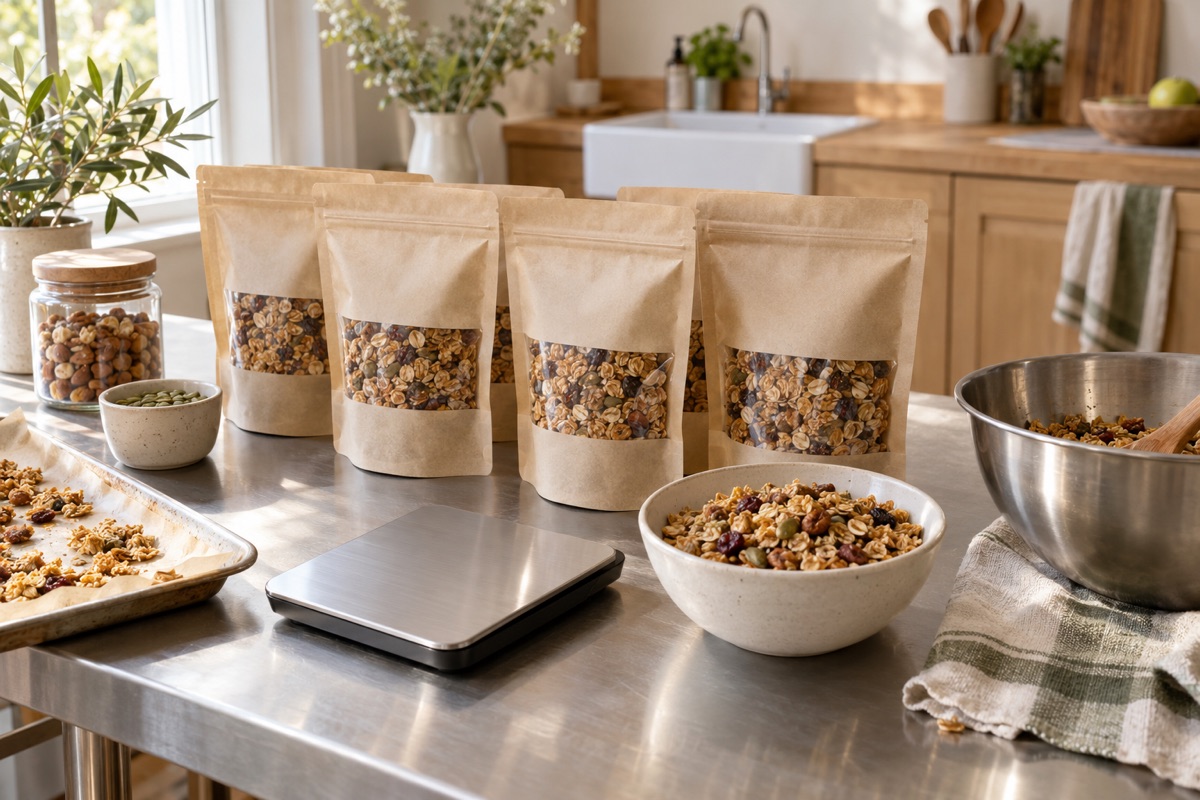
For a small granola business, choose packaging in this order: describe the granola, decide the batch size and where you sell, shortlist pouch formats, then test sample pouches before you buy in volume. Granola is a dry product that loses crunch when it takes in moisture, so the closure and the film usually matter more than the printing. Labeling, licensing and cottage food rules depend on the state or country where you sell, so confirm them early.
This guide covers the selection process. For what a gusset, zipper or window actually does, read stand-up pouches for granola.
Who this is for
Home and small-kitchen granola makers who are starting to sell, through a market, online or to a local shop, and who need a way to pick packaging without guesswork. No packaging experience is assumed.
Start with the product
Packaging should answer to the granola, so list its traits first.
Texture comes first. Fine, loose granola behaves differently from large clusters, which break under pressure, so a pouch that gets squeezed in shipping may turn them to crumbs. Moisture matters too: dried fruit and honey-heavy mixes carry moisture, which can soften nearby pieces, while dry mixes are more sensitive to moisture from outside. Nuts and seeds contain oils that can go stale over time, and light and air are the usual concerns.
Granola often contains tree nuts, wheat, sesame, milk or soy. The FDA lists nine major allergens, and they must be handled in the recipe, on the label and in how you pack.
Then think about appearance and shelf life. If customers need to see the granola, a window shows the product but reduces protection from light. And decide how long you want it to last on a shelf or in a home pantry. That is something to validate, not assume.
For how granola behaves at home, see how to store homemade granola once it is in the pantry; this article is about packaging for sale.
Decide batch size and channel
| Question | Why it matters |
|---|---|
| Batch size | A batch that sells within a short window needs less shelf-life protection than one that sits in stock. |
| Pack sizes | Offer one size at first. Every extra size adds another pouch to buy, test and label. |
| Channel | Farmers market, local delivery, a shop shelf, mail order. Each puts different stress on the pouch. |
| Handling | Will pouches be stacked, shipped or hung on a peg? |
| Fill method | Scooping by hand, a funnel or a scale. Wide-mouth pouches are easier to fill by hand. |
| Closure | Zipper for repeat use, or a simple fold-and-seal for single use. |
Write the answers down in the template from the food packaging brief. It is easier to compare quotes when suppliers all get the same description.
Shortlist the format
Pouch formats are explained in the companion article, so this list is only about trade-offs for a small seller.
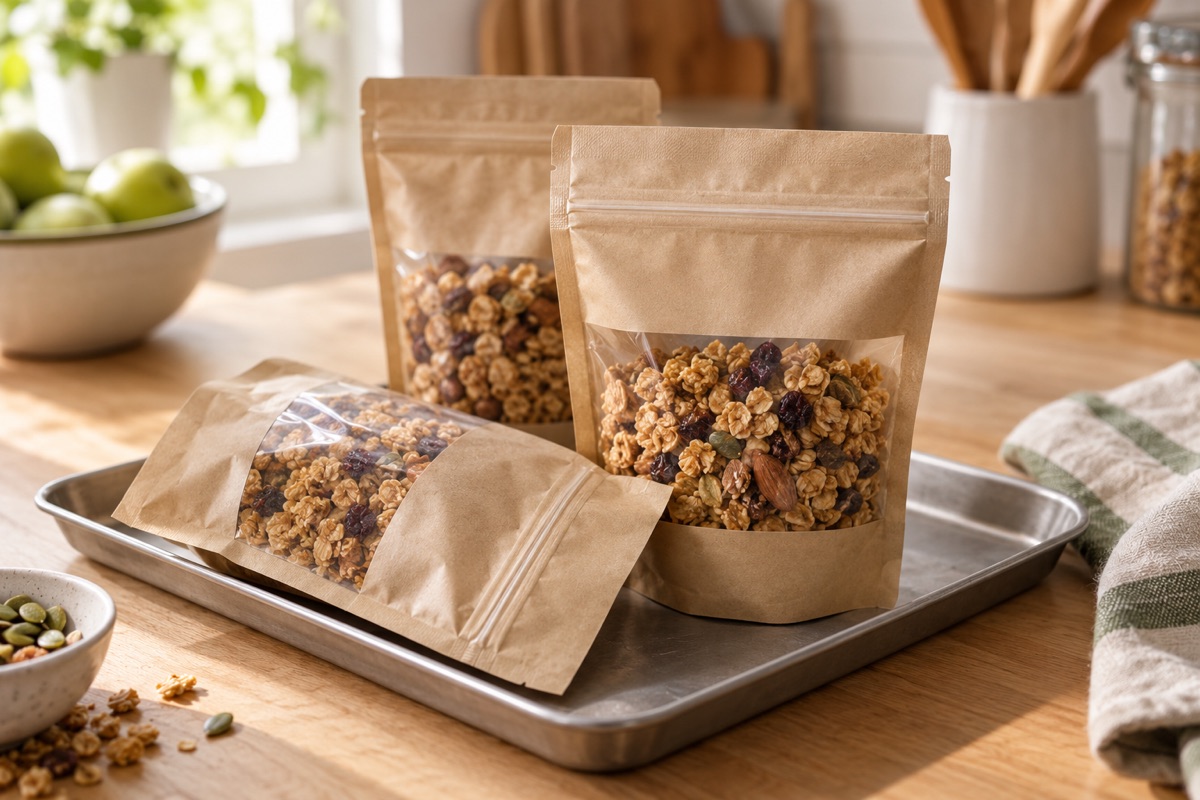
A stand-up pouch with a zipper sits upright on a table and reseals, and it is a common choice for granola sold directly to customers. A flat or pillow pouch is simple and lighter, but does not stand once opened. A window or clear pouch shows the product, with less light protection, while an opaque pouch blocks light better but customers cannot see inside. A rigid container such as a jar or tin is better against crushing, but heavier and more costly to ship.
Suppliers describe film properties in technical sheets. Ask for the moisture and oxygen transmission rates with the test conditions, and for confirmation that the material is intended for food contact. The FDA’s consumer page says packaging and its components are food contact substances, and that certain uses must be authorized before they are marketed. A reputable supplier should be able to explain how its material meets that standard.
Test the sample pouches
Order small samples, or make test packs from the pouches you have, and run them through your real process.
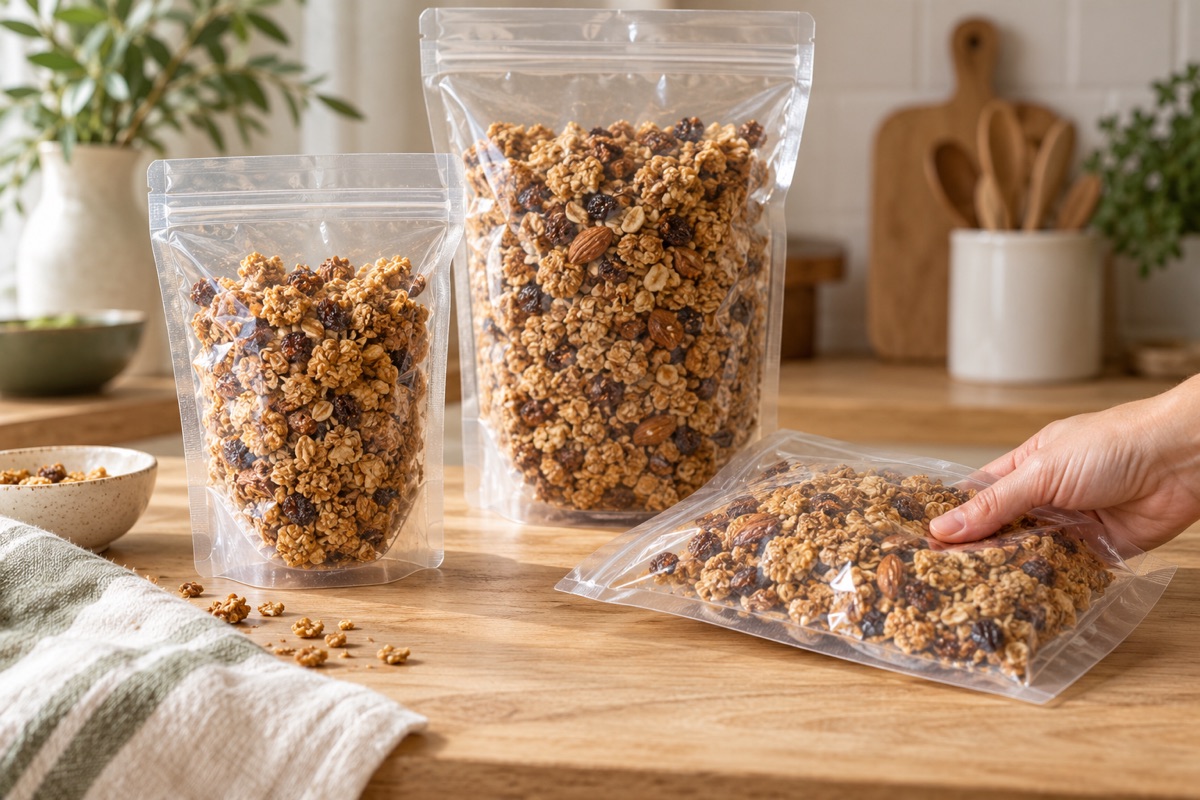
- Fill a batch of pouches by hand the way you will on a busy day. Note how long it takes and how much spills.
- Close each pouch and press on it gently. Look for air leaking from the seams or the zipper.
- Place a light weight on top for a while and open the pouch to see whether the clusters broke.
- If you will mail it, pack and ship a sample to yourself.
- Keep sealed samples for the full period you plan to sell them. Check crunch, smell and appearance at set intervals. Texture and smell are quality checks and say nothing about safety.
- Ask someone unfamiliar with the pouch to open and reseal it.
Shelf life and safety need proper validation. A pouch that kept granola crisp for a week has not shown it is stable at a month. How to set a best-by date depends on your recipe and your state, so ask your state food program, an extension food scientist or a laboratory, and do not borrow a date from someone else’s granola.
Rules to check before you print a label
The FDA’s Food Labeling Guide summarizes federal label statements, and the FDA says it does not pre-approve labels. Allergens must be declared according to federal rules, so check the details against your ingredients, including any added flavors.
If you operate under a state cottage food law, the state may require specific label wording and limit where and how you can sell. Maryland’s extension guide shows this, and its required statement applies only in Maryland. Selling online, across state lines or to shops often changes which rules apply.
Cost assumptions
Pouch prices, minimum order quantities and label costs differ by supplier and change over time, so no figures appear here. Collect your own quotes, label them as assumptions, and calculate the cost per filled pouch, including testing waste, labels and any shipping materials. The packaging cost calculator gives you a place to do that.
When to get professional help
Get help if you are unsure which rules cover your sales channel, if you want to make claims such as “low sugar” or health claims on the label, if you need a defensible shelf-life determination, or if you plan to scale to wholesale or retail chains.
Contact your state health or agriculture department, your state extension office, or a food scientist.
Next steps
- Write the product traits and channel in the packaging brief template.
- Shortlist two or three formats, using the pouch comparison.
- Test samples, then estimate unit cost with the calculator.
- Check labeling rules with your state.
- If you need a granola recipe to test with, a standard one is in the homemade granola recipe.
Sources
- Guidance for Industry: Food Labeling Guide , U.S. Food and Drug Administration (accessed October 4, 2026) Federal summary of required label statements. The FDA does not pre-approve labels.
- Food Allergies , U.S. Food and Drug Administration (accessed October 4, 2026) Lists the nine major food allergens, including tree nuts, wheat and sesame, which are common in granola.
- Food Packaging & Other Substances that Come in Contact with Food - Information for Consumers , U.S. Food and Drug Administration (accessed October 4, 2026) Packaging is a food contact substance and certain uses must be authorized before marketing.
- Cottage Food Business Law , University of Maryland Extension (accessed October 4, 2026) One state's cottage food and labeling rules, used as an example of how state rules work.