
Stand-Up Pouches for Granola: What to Compare
What the parts of a granola pouch do: base gusset, zipper, tear notch, window and film layers, so you can read a package and judge how well it keeps granola crisp.
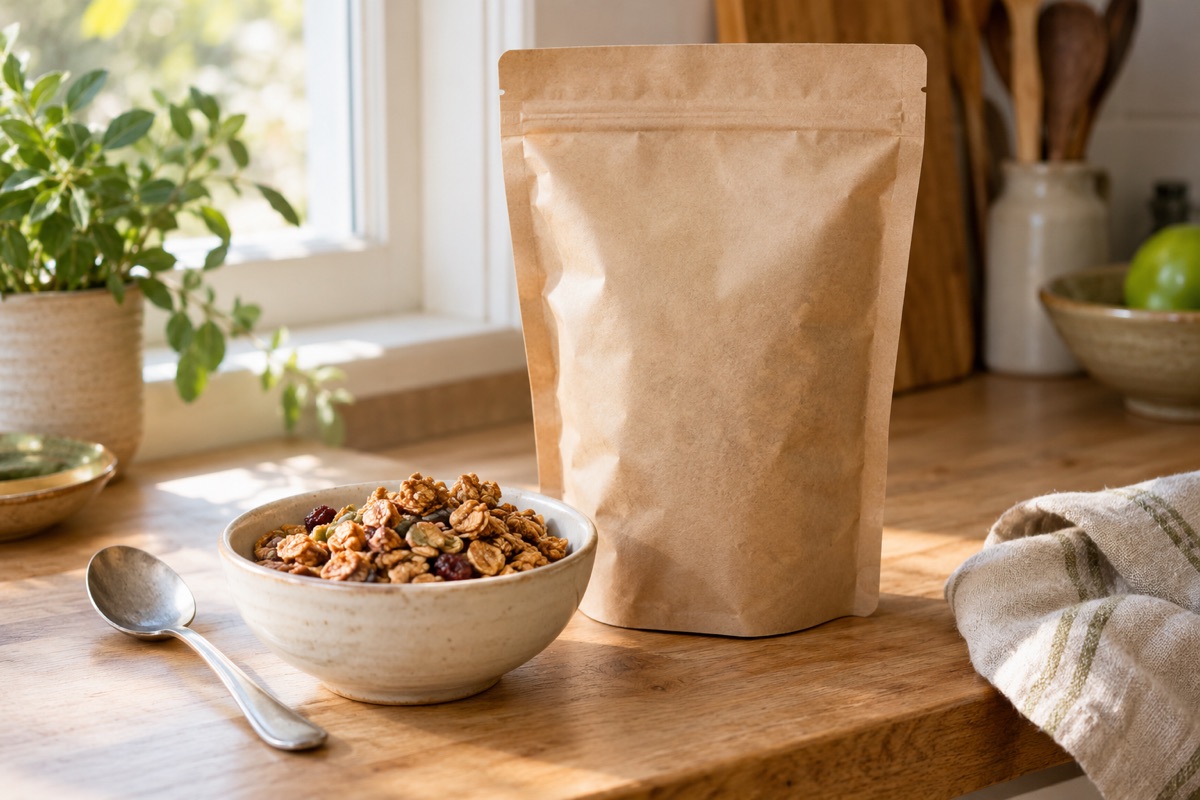
A stand-up pouch keeps granola crisp mainly through three things: a film that slows moisture, a seal with no gaps, and a closure you actually use after the first opening. The shape, the window and the printing matter less for crunch. This article explains each part so you can read a package, whether you are buying granola or packing a batch you made at home.
If you are choosing pouches for a food business, the buying steps and testing plan are in granola packaging for a small food business. This page is only about what the parts of a pouch do.
Why granola needs a pouch that closes well
Granola is dry and crunchy, and it loses crunch as it takes up moisture from the air. A package left open between servings lets in room air each time. That is why a reclosable pouch is common for granola, and why a good closure matters as much as the film. The storage side of this, including containers at home, is covered in how to store homemade granola and keep its crunch.
The shapes you will see
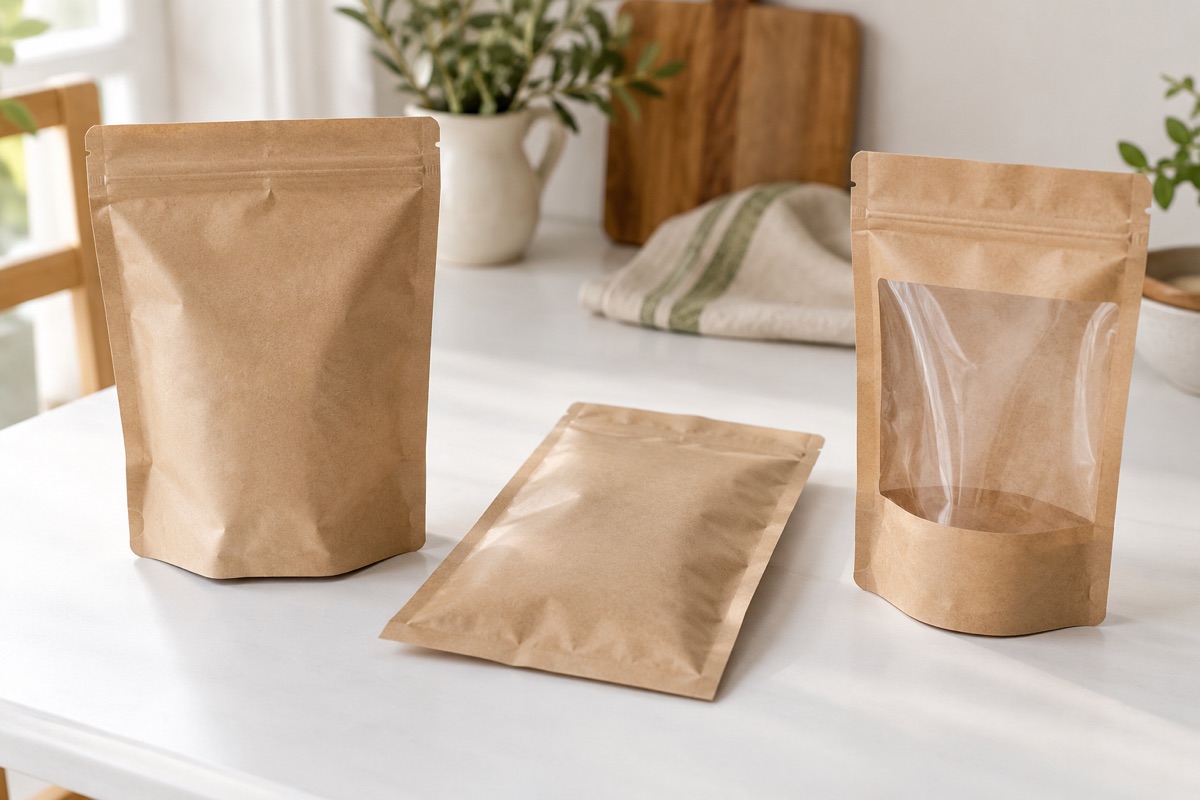
A stand-up pouch has a folded base gusset, so it opens out into a flat base and stands on a shelf or counter. It is easy to scoop from, easy to see on a shelf, and stores upright in a pantry.
A flat or pillow-style pouch is sealed on the top and bottom and often along the back. It lies flat and is simple, but it will not stand up once opened.
Gusseted side pouches and box-bottom bags have folds along the sides that add volume and a squared shape. They are more common for larger quantities.
A window pouch has a clear panel that lets you see the product. The clear section is a film too, so look at whether it is part of the same laminate or a separate piece.
The closure and the opening
Look at how the pouch opens and closes before you look at how it looks.
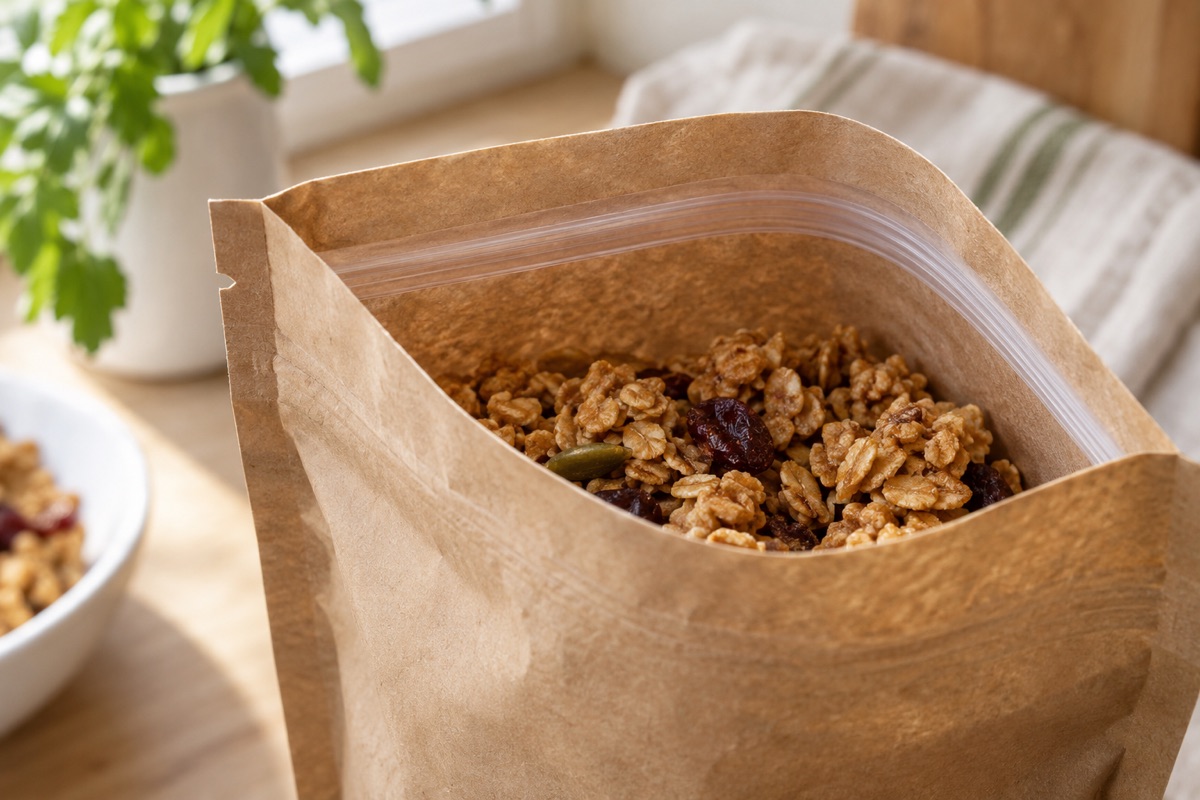
The zipper (a press-to-close track) sits just below the top edge and gives a repeatable seal for daily use. Press along the whole track and check that it is closed all the way across, with no granola caught in it. A small tear notch near the top lets you tear the pouch open cleanly above the zipper. Tear above the zipper, not below it, or you lose the closure. A hang hole punched in the top lets a retailer hang the pouch on a peg and does not affect the contents.
If the zipper is the only closure, treat it as a convenience, not a guarantee. A zipper can leak small amounts of air, so for long-term storage a clip or a second container can help.
What the walls are made of
Most stand-up pouches are laminates, meaning several thin layers bonded together. A typical structure has an outer layer for print and strength, a middle layer that slows the passage of moisture and oxygen, and an inner layer that melts to form the seal.
Kraft-look paper exteriors are common on granola pouches. The paper layer is usually backed by a plastic film inside, so it is the film, not the paper, that does most of the barrier work. Clear films show the product but usually let in more light than an opaque pouch. Metalized or foil-containing films are opaque and are generally chosen for stronger barriers against moisture, oxygen and light. They are not see-through, and they cannot be microwaved.
When a supplier lists numbers for a film, such as water vapor transmission rate or oxygen transmission rate, the numbers only mean something alongside the test conditions: temperature, humidity and film thickness. Compare numbers from the same test method, and treat any figure without conditions as incomplete. This article does not give barrier values, because they vary by film and test.
Anything that touches food is a food contact substance. The FDA’s consumer page says food contact substances include food packaging and its components, and that a food contact substance that is a food additive must be authorized for its use before it is marketed in the United States. As a shopper, you will see this reflected in packaging described as “food grade.” The FDA keeps an inventory of food contact notifications and guidance for industry on its packaging page.
Reading a granola pouch in the store
You can check a pouch without opening it.
- Press the zipper track between your fingers and look for a continuous line.
- Look at the top and bottom seals. They should be flat and even, with no wrinkles or channels.
- Check for tiny holes or crushed corners.
- Look at the base. A well-formed gusset sits flat and the pouch stands without support.
- If there is a window, see whether the granola looks the way the description says: loose clusters rather than crumbs.
- Check the best-by date and storage directions on the label. Product labels take priority over general advice.
Some pouches have a one-way degassing valve. That feature belongs to coffee, which releases gas after roasting. Granola does not release gas the same way, so a valve on a granola pouch deserves a question. For how seals and closures work in other snack bags, see how chip bags are sealed.
What a pouch cannot do
A pouch does not make a recipe last longer than its ingredients allow. Nuts and oils can go stale, and fruit pieces carry their own moisture, which can soften clusters from the inside. No closure fixes that. A pouch also does not replace refrigerator or freezer storage when a product label calls for it.
At home
If you make granola yourself, a plain stand-up pouch with a zipper is one way to package gifts or small portions, and the same principles apply to the jar or tin you use at home. Fill the container to a sensible level, press out excess air, close the closure fully, and store the package in a cool, dry place. If you want a batch to pack, the homemade granola recipe is one place to start.
Sources
- Food Packaging & Other Substances that Come in Contact with Food - Information for Consumers , U.S. Food and Drug Administration (accessed October 4, 2026) Explains that packaging and its components are food contact substances and how the FDA reviews them.
- Packaging & Food Contact Substances (FCS) , U.S. Food and Drug Administration (accessed October 4, 2026) Entry point for FDA guidance and the inventory of food contact substance notifications.