
How to Store Coffee Beans After Opening the Bag
After you open a bag of coffee beans, air, light, heat and moisture start working on them. Here is how to close the bag, choose a container and decide about the freezer.
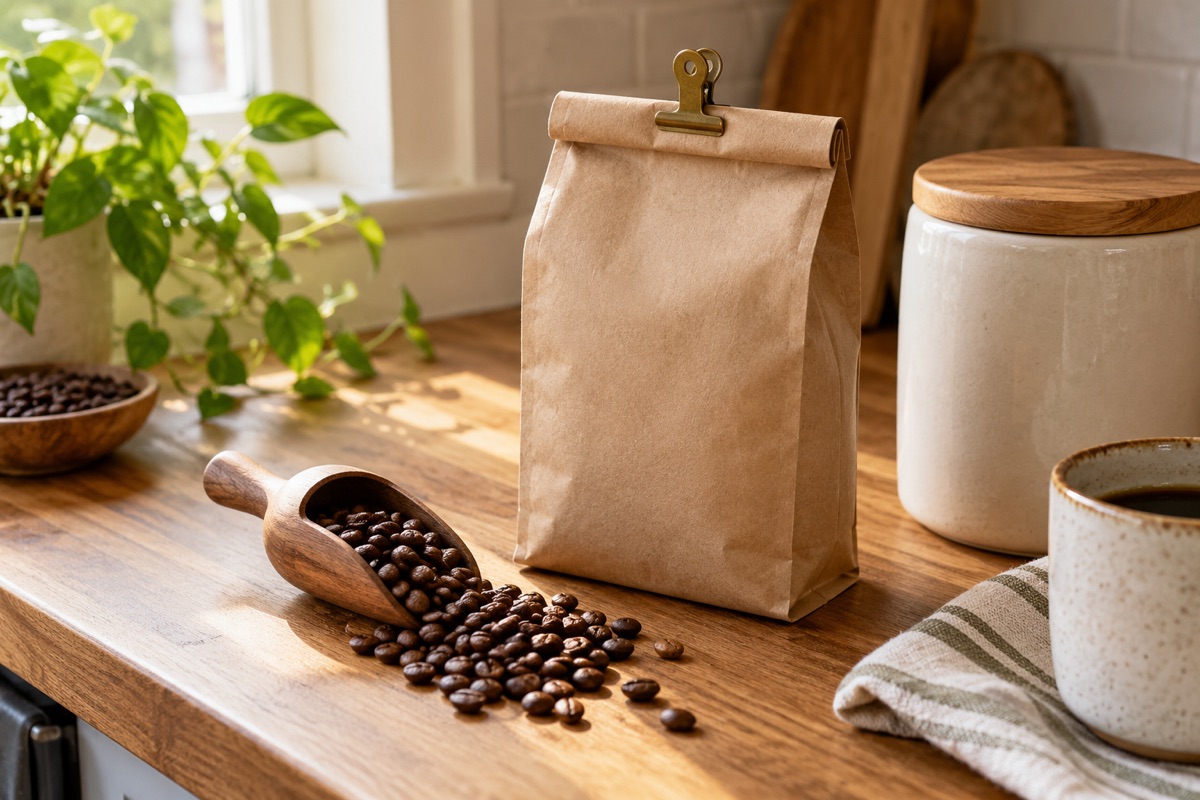
Once a bag of coffee beans is open, the aim is to keep air, light, heat and moisture away from the beans. Close the original bag as tightly as you can, or move the beans to an opaque, airtight container, and keep it somewhere cool and dark. Buy amounts you expect to use in a week or two.
Roasted coffee is a dry, shelf-stable food, so this is about flavor rather than safety. Coffee that has lost its aroma is stale, not dangerous. The one real safety risk is moisture: the National Coffee Association says old roasted beans generally do not become unsafe to brew unless they have been exposed to moisture and developed mold. This guide applies to readers in the United States and was last reviewed on October 4, 2026.
What is happening to the beans
Fresh roasted coffee loses freshness in two ways: it releases carbon dioxide formed during roasting, and its aroma compounds fade. A study from the Zurich University of Applied Sciences notes that roughly 1% of the weight of freshly roasted coffee is carbon dioxide, and that whole beans keep releasing gas for about a month. The valve on many coffee bags handles that gas, as explained in why coffee bags have valves.
The same study says that once a bag is opened, the protective atmosphere inside it changes, which speeds up the loss of freshness. Oxygen matters a great deal. In a laboratory test on roasted and ground coffee, raising oxygen from 0.5 to 21.3 kPa (about the level in ordinary air) made the coffee deteriorate about 20 times faster, and a rise in water activity of 0.1 made it about 60% faster. A 10°C rise in temperature changed the rate far less, about 15 to 23%. These figures come from one study of ground coffee stored under constant, controlled conditions, so treat them as a picture of which factors matter most, not as a timetable for your kitchen.
If your bag was packed in a gas that replaced the air, that only applied until you opened it. The idea is covered in nitrogen flushing in coffee packaging.
Quick steps
- Check the label. An unopened bag is fine until the best-by date, according to the National Coffee Association.
- Squeeze out extra air when you close the bag, and roll it tightly. Less air space means less air to react with the beans.
- Close it fully each time. In the study described below, clips and tape did not hold up as well as a screw cap.
- Store it in a cool, dark place. Avoid cabinets near the oven or dishwasher and spots in strong afternoon sun.
- Keep whole beans whole and grind only what you need just before brewing.
- Buy smaller amounts more often, enough for one or two weeks as the National Coffee Association suggests.
Containers and closures compared
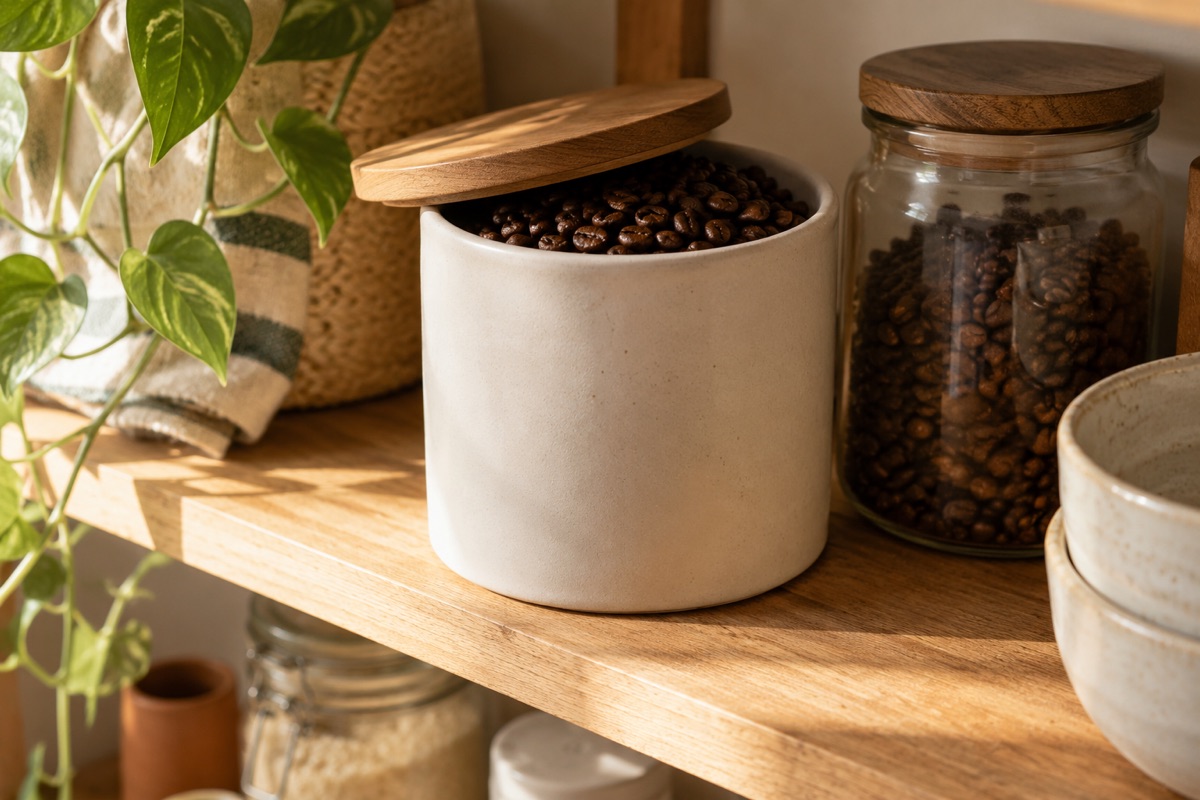
The Zurich team compared four ways of storing whole roasted beans after opening, using beans that had been packed under nitrogen in valved bags and rested for three weeks. Over nine weeks, they tracked chemical markers of aroma loss after each opening. In their words, the package with an integrated screw cap performed best, while re-closing the bag with a clip or tape, or moving the beans to an airtight canister, led to a faster loss of freshness. The canister and tape methods showed the largest changes.
That result is easy to misread, so here are the conditions. The test was a chemical analysis, not a taste panel, and the authors say sensory studies are still needed. Each method involved opening the package and taking out 49 g twice a week, which let fresh air in every time. A canister filled to the brim and opened less often may behave differently. The practical lessons are narrower:
| Option | What it does well | Watch out for |
|---|---|---|
| Original bag, rolled and clipped | No extra step; beans stay in the packaging they came in | In the study above, clip and tape closures lost freshness faster than a screw cap |
| Bag with a resealable screw cap or similar | Performed best in the study above | Only applies if the bag has one |
| Opaque airtight canister | Blocks light; holds beans from several bags | In that study, moving beans to a canister did not slow staling; each opening still lets in air |
| Clear glass jar | Easy to see the beans | Light reaches the beans, which the National Coffee Association says can compromise taste |
The National Coffee Association advises moving coffee out of retail packaging into an airtight container, because retail bags are not designed for long-term storage, and using opaque containers. The study points in a slightly different direction, so choose by habit. If you reseal a bag well and finish it in a couple of weeks, the bag is fine. If you buy large bags, splitting them into smaller portions means you open the main supply less often.
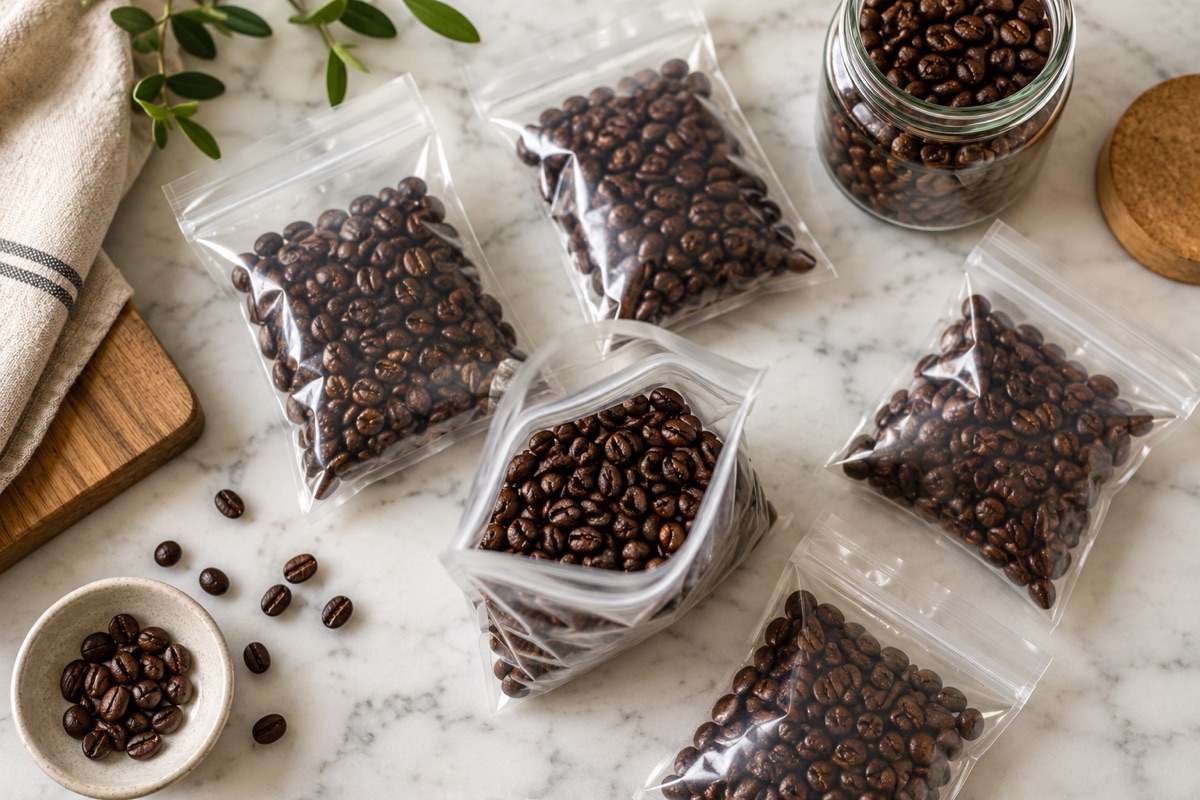
Airtight and vacuum-sealed storage are not the same thing, and neither is a safety tool. The difference is explained in airtight versus vacuum-sealed storage.
Pantry, fridge and freezer
For everyday use, the pantry is the usual choice. The National Coffee Association gives these ranges for how long opened coffee keeps its freshness, assuming it has been moved to airtight containers:
- roasted beans at room temperature: 1 to 3 weeks
- roasted beans refrigerated: 2 weeks
- roasted beans frozen: 3 to 4 months
- ground coffee at room temperature: 1 to 2 weeks
These are quality ranges from one trade association, not safety limits, and they describe aroma and flavor.
The Association notes there are differing views on freezing coffee. Coffee absorbs moisture and odors from the air around it, so a refrigerator or freezer can add condensation or off-flavors. If you freeze beans, it recommends a truly airtight container, taking out no more than about a week’s worth at a time, and putting the rest back before condensation forms on the beans. Freezing is probably most useful in a humid climate.
Common questions
Do the beans go bad? They lose aroma and taste flat, but the National Coffee Association says they are generally not unsafe unless moisture has led to mold. Throw out beans that look or smell moldy.
Is the valve on the bag enough? It lets gas out of an unopened bag. It does not help once the bag is open and the beans are mostly exposed to air.
Should I buy whole beans or ground? Both lose freshness. Ground coffee has more surface exposed, so the Association recommends airtight storage especially for pre-ground coffee, and grinding just before brewing when possible.
What if the label says something different? Follow the label. Product instructions and dates take priority over general guidance.
Official guidance and review date
This guide was reviewed on October 4, 2026 and applies to the United States. It relies on the National Coffee Association, a 2022 open-access study from the Zurich University of Applied Sciences, and a 2001 study abstract from the University of Minnesota. Coffee flavor timelines are not food safety limits. For refrigerator and freezer safety charts, see the FoodSafety.gov cold food storage chart, linked in the food safety note below.
Official guidance and sources
Sources last checked October 4, 2026.
- Storage and shelf life , National Coffee Association (About Coffee) (accessed October 4, 2026) Airtight, opaque, cool and dark storage; guidance on freezing; quality (not safety) time ranges.
- Effects of different coffee storage methods on coffee freshness after opening of packages , Food Packaging and Shelf Life (Zurich University of Applied Sciences) (accessed October 4, 2026) Open-access study comparing four ways of storing whole beans after the bag was opened.
- Application of Weibull Hazard Analysis to the Determination of the Shelf Life of Roasted and Ground Coffee , LWT, University of Minnesota (Experts@Minnesota) (accessed October 4, 2026) Abstract used for the effect of oxygen, moisture and temperature on roasted and ground coffee.