
How Are Potato Chip Bags Sealed?
Chip bags are closed by heat sealing: plastic layers inside the bag are fused with heat and pressure. Here is what the seams are, why the bag is puffed and how it opens.
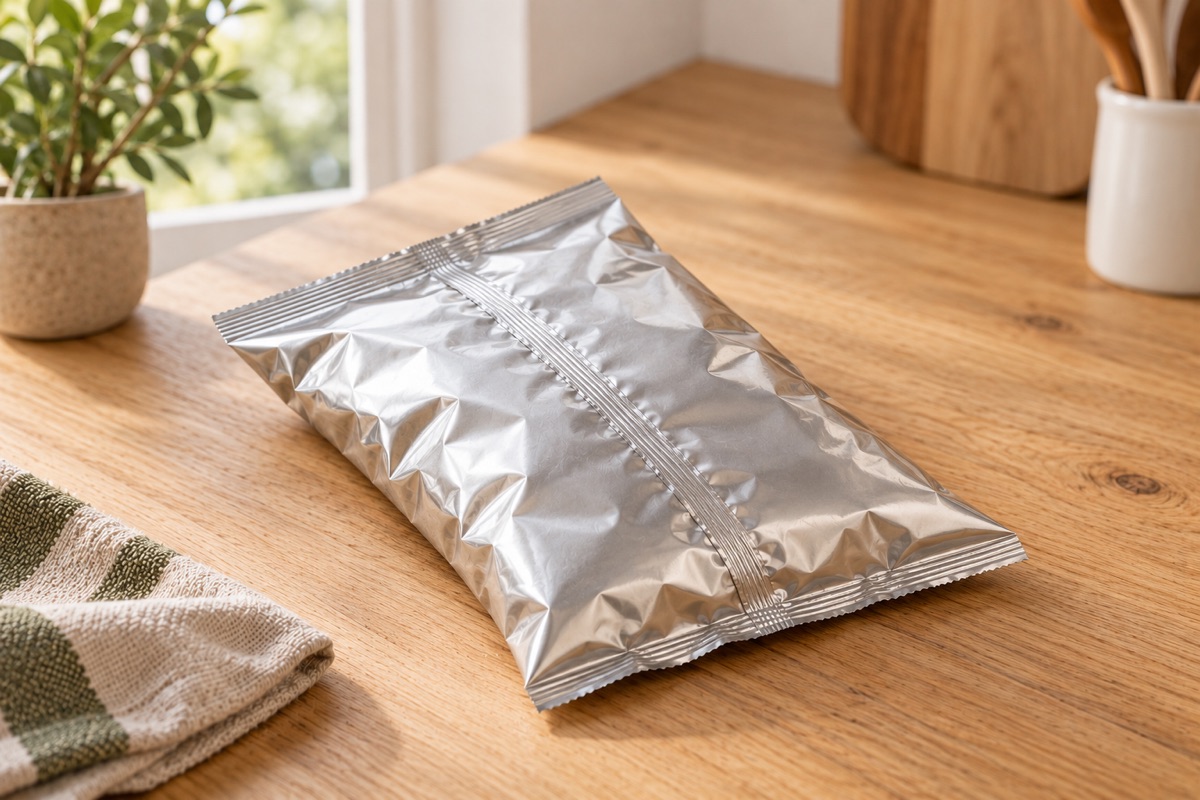
A potato chip bag is closed by heat sealing. The inside layer of the film is a plastic that melts when heated, and pressing two hot surfaces together fuses them into a seam. The crimped top and bottom edges and the seam down the back are all places where that fusing happened. A puffed bag often holds added gas, though not every bag is flushed.
This article explains the idea from published technical sources. It does not describe any one company’s equipment, and it does not claim visits to a factory or tests of our own.
What you see on the package
Turn a chip bag over. There is a band of fine ridges across the top and another across the bottom, and often a vertical seam down the back. The bag is usually plump, and the inside of the film often looks shiny and metallic.
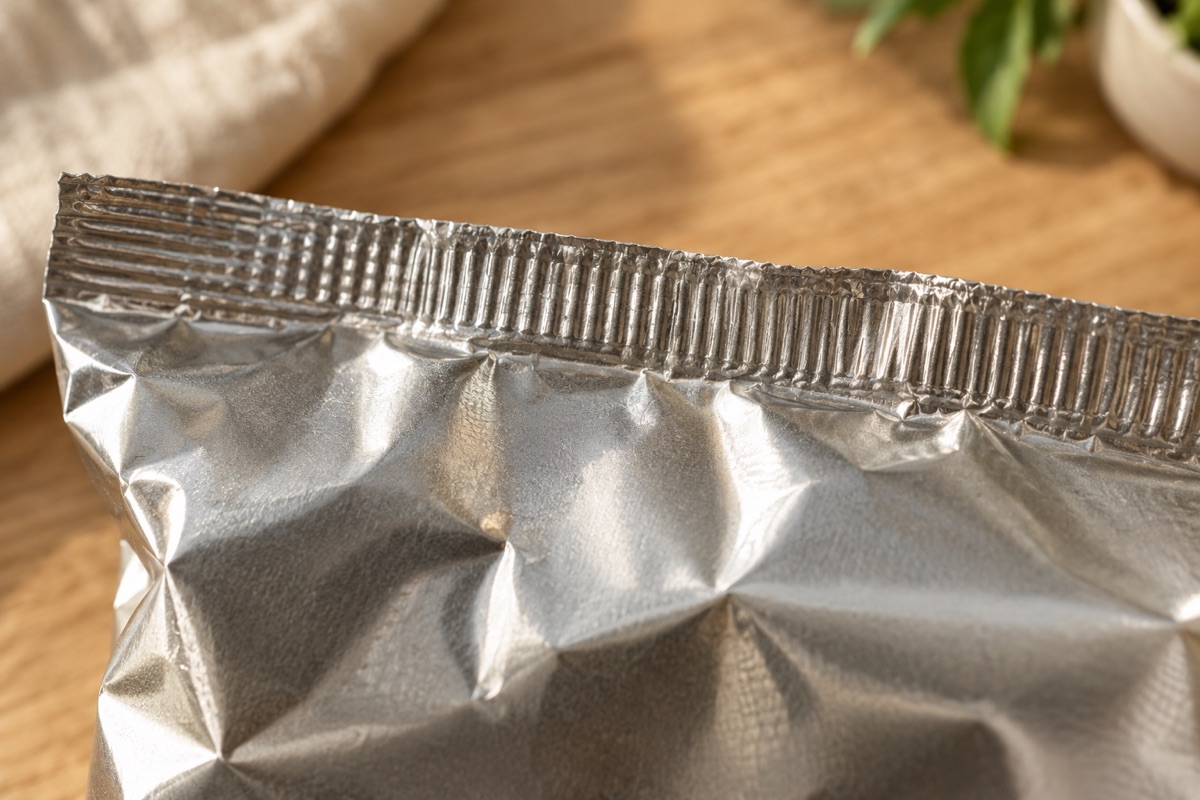
The bag film is a laminate, meaning several thin layers stuck together, each doing a different job. In one published study of seasoned potato crisps, the pack was described as a laminate of matte OPP and metallized OPP film, meaning plastic films, one of them with a metallized layer. That study does not say which layer does the sealing, so this article does not either.
How heat sealing works
The Wikipedia article on heat sealers defines the process as sealing one thermoplastic to another similar thermoplastic using heat and pressure. A thermoplastic is a plastic that softens when heated and hardens again as it cools.
In the direct contact method, a heated bar or die presses on a narrow strip of film, and the heat travels through the film to the inner surfaces and welds them. The same source lists several versions. Hot bar sealers keep their tooling at a constant temperature and press it against the film. Continuous band sealers use moving belts over heating elements. Impulse sealers pass current through a heating element only for a set time, then keep the jaws closed, sometimes with cooling, so the material fuses before any stress is applied.
These sources don’t say which kind a snack maker uses, and it varies between plants. The principle is shared.
Heat, pressure and time work together. The source states that good seals result from the right time, temperature and pressure applied to correct, clean material. Seal strength is measured because it shows how consistent the seals are and how much force it takes to open the package. Standard test methods include peel testing under ASTM F88 and F2824, which measures the strength of seals in flexible barrier materials. Package-level tests such as burst and creep testing (ASTM F1140 and F2054) check how a finished package holds up under pressure.
Why the bag is puffed
A chip bag is often only partly full of chips, with gas taking up the rest. One reason is protection: delicate chips crush easily. Another is oxidation. The University of Nottingham crisps study notes that the oxygen in a pack speeds the rancidity of the oil in the chips. In that study some packs were flushed with nitrogen before sealing, leaving a residual oxygen content below 3.5%. Flushing is explained in nitrogen flushing in coffee packaging, and the same idea applies to snacks.
The Wikipedia page on vacuum packing makes a related point: for delicate foods that might be crushed, such as potato chips, an alternative to vacuum packing is replacing the interior gas with nitrogen. Not every bag is flushed, and a puffed bag does not prove that it was.
Compared under real conditions
The sources give limited, specific facts, so here they are with their conditions.
In the Nottingham study, packs were stored at 45°C for 10 weeks to age them quickly. Flushing significantly increased shelf life in terms of flavor stability and sensory perception, with the paper’s highlight line giving about two weeks under those accelerated conditions. Rancidity and staleness still developed in both flushed and unflushed packs. This is one product under one set of conditions.
Seals can also be weak points. Wikipedia’s entry on oxygen transmission rate says finished packages involve heat seals, creases, joints and closures that often reduce the effective barrier of the package, so the film’s own barrier is not the whole picture.
What a heat seal can and cannot do
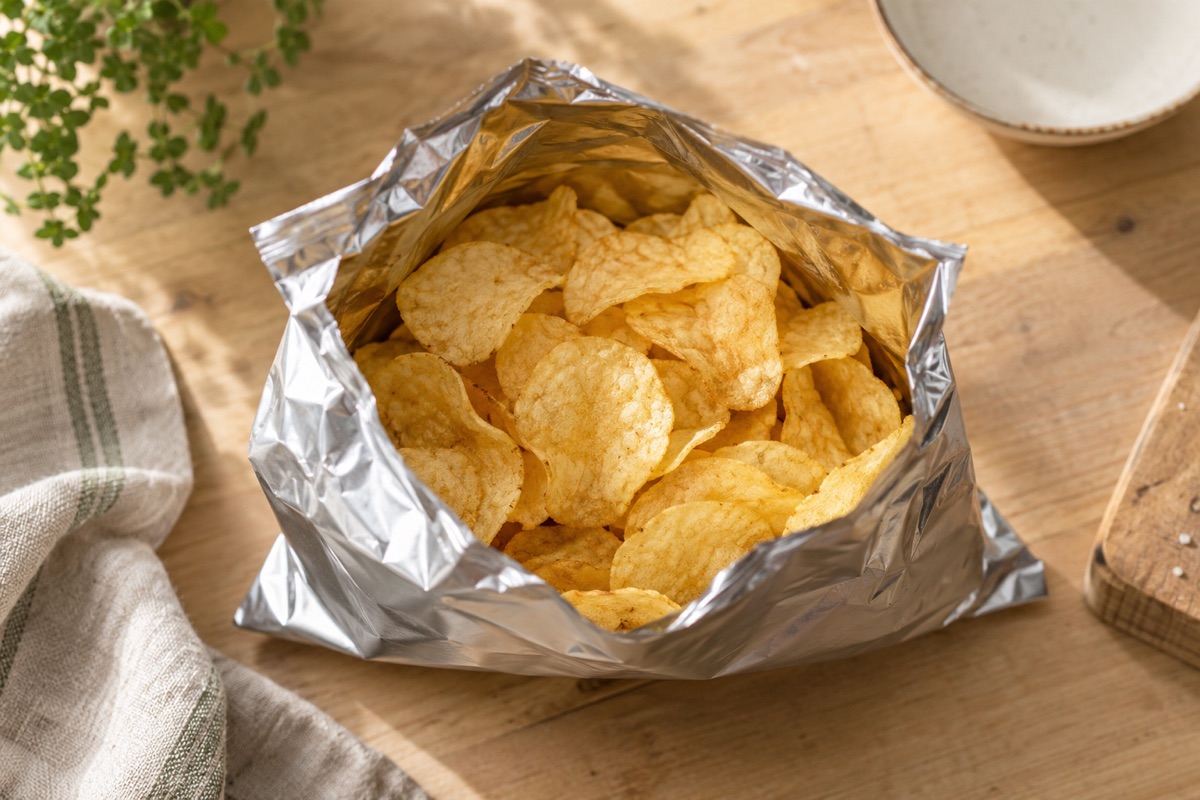
A heat seal closes the bag along a narrow, repeatable strip, holds a gas such as nitrogen in until the bag is opened, and can be tested for strength by standard methods.
It cannot guarantee freshness. Seal quality depends on correct time, temperature, pressure and clean material, and a flaw can let air in. It does not last after opening: once the seam is torn, the bag is no longer sealed, however tightly you fold it. And it says nothing about food safety. A sealed bag is a packaging fact, not a safety verdict.
The earliest chip packaging was simpler. Wikipedia’s potato chip page describes Laura Scudder in the 1920s having workers iron sheets of wax paper into bags, which reduced crumbling and kept chips fresh and crisp longer. It says that this, together with the invention of cellophane, helped potato chips become a mass-market product.
What it means at home
A clip or a rolled top on an opened chip bag holds the bag shut but does not heat-seal it. For chips you plan to eat within a day or two that is probably enough. For longer storage you would be relying on your closure rather than the factory seal. Home granola and other dry snacks face a similar choice between a clip, a jar or a resealable pouch, covered in how to store homemade granola and in granola stand-up pouches.
If a bag arrives torn at the seam, with a visibly open edge or no puff at all, the seal may have failed. Use judgment about whether to keep it, and follow any instructions on the label. A puffed bag alone is not a guarantee, and a flat bag alone is not proof of a problem, because not every product is gas flushed.
Sources
- Heat sealer , Wikipedia (accessed October 4, 2026) How heat sealing works, types of sealers, and how seal quality is tested.
- The impact of nitrogen gas flushing on the stability of seasonings (cheese & onion seasoned potato crisps) , Food & Function, University of Nottingham (PubMed Central, open access) (accessed October 4, 2026) Describes the pack material and nitrogen flushing used in one published crisps study.
- Potato chips , Wikipedia (accessed October 4, 2026) History of chip packaging, from ironed wax paper bags to cellophane.
- Oxygen transmission rate , Wikipedia (accessed October 4, 2026) Why seals and creases can reduce a finished package's barrier.