
How to Package Cookies for Sale: A Planning Checklist
A planning checklist for small sellers: define the cookie, the quantity, the sales channel and the protection it needs, then test samples before you buy packaging in volume.
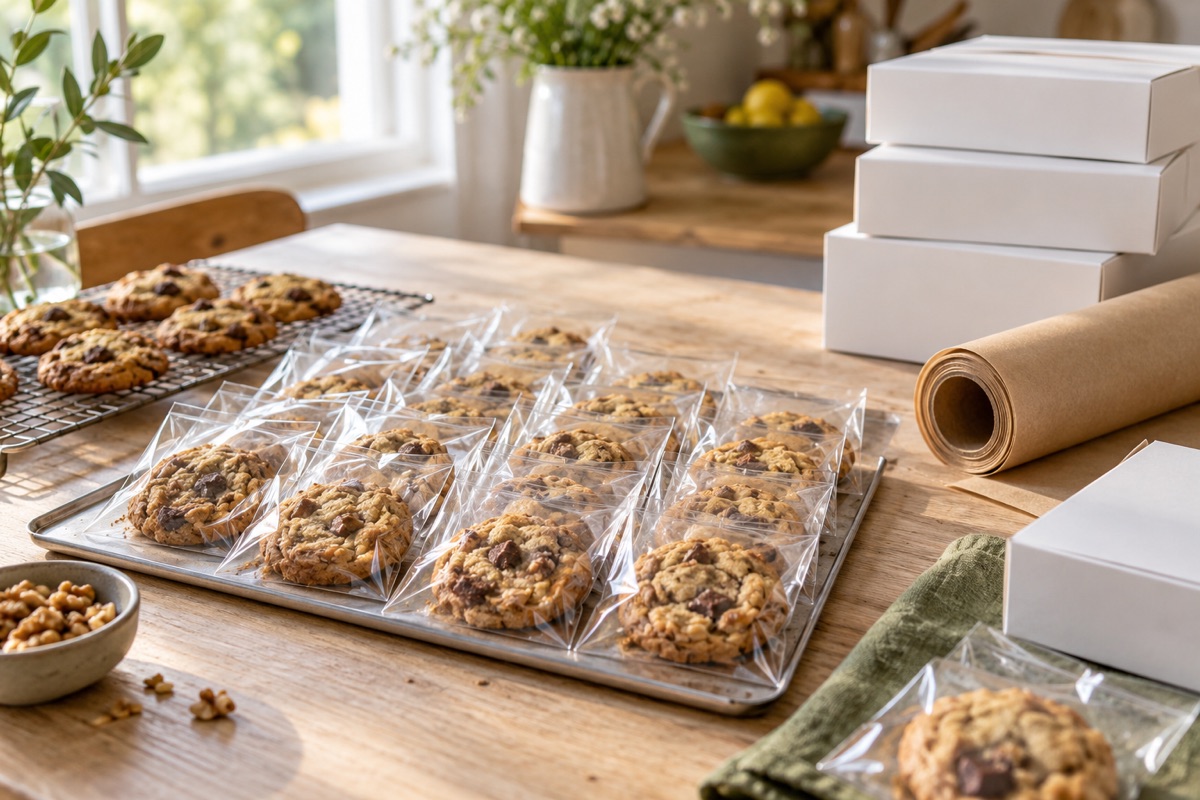
Packaging cookies for sale starts with four decisions: what the cookie is, how many you will make, where you will sell it, and how much protection it needs. Make those decisions before you pick a bag or a box, then test samples. This is a planning checklist, not legal advice. Labeling, licensing and cottage food rules depend on the state or country where the product is sold, and you need to check them for your own location.
If you are giving cookies away rather than selling them, packaging cookies for gifts is a simpler path.
Who this is for
This is for home bakers and small bakeries who are moving from giving cookies away to selling them: at a market, to local customers, to a shop or by mail. It assumes you already have a recipe you like. It does not assume you have chosen packaging, a label or a business structure.
Rules come first, and they depend on where you sell
Packaging and labeling are part of the same decision, so look up the rules early.
In the United States, the FDA’s Food Labeling Guide summarizes the statements that must appear on packaged food labels under federal law. The FDA states that it does not pre-approve food labels, and that keeping up with changes is the responsibility of the maker.
The FDA lists nine major food allergens: milk, eggs, fish, crustacean shellfish, tree nuts, peanuts, wheat, soybeans and sesame. Cookies often contain several of these, so check how they must be declared on a label.
The FDA also describes exemptions from nutrition labeling, including one for low-volume products and another for certain small retailers. Whether any applies depends on your numbers and your claims, so read the FDA page itself rather than relying on a summary.
Many states have a cottage food law that lets certain low-risk foods be made at home and sold directly, with its own limits. State extension offices publish plain-language guides. The University of Maryland Extension guide, for example, sets out label content including a required statement for cottage food businesses. That statement is specific to Maryland and should not be copied elsewhere.
If you sell in another country, this checklist is only a starting point. Use that country’s food authority.
Ask your state or local health or agriculture department what applies to a cookie business like yours, and whether a licence, registration, kitchen inspection or label review is needed.
Decision checklist
Write down your answers. Anything you cannot answer is a question to resolve before you order packaging.
| Question | What to decide |
|---|---|
| Product | Crisp, chewy or soft? Plain, filled, iced, or with chocolate? Each one breaks, sticks or melts differently. |
| Quantity | How many cookies per package, and how many packages per week or per event? Start small enough that nothing sits unsold. |
| Channel | Hand to the customer, local delivery, a shop shelf, or mail? The longer the trip, the more protection you need. |
| Protection needs | Moisture, crushing, sticking, heat, scent transfer between flavors. |
| Presentation | Do customers need to see the cookie? Is a window or a clear bag worth the loss of protection? |
| Label space | Can the package carry the required label statements clearly? |
| Storage and handling | Where will it sit before sale? How will you tell customers to store it? |
| Budget | What is the most you can spend per unit? Use the packaging cost calculator and mark every number as an assumption. |
Options and limits
Each format solves some problems and leaves others.
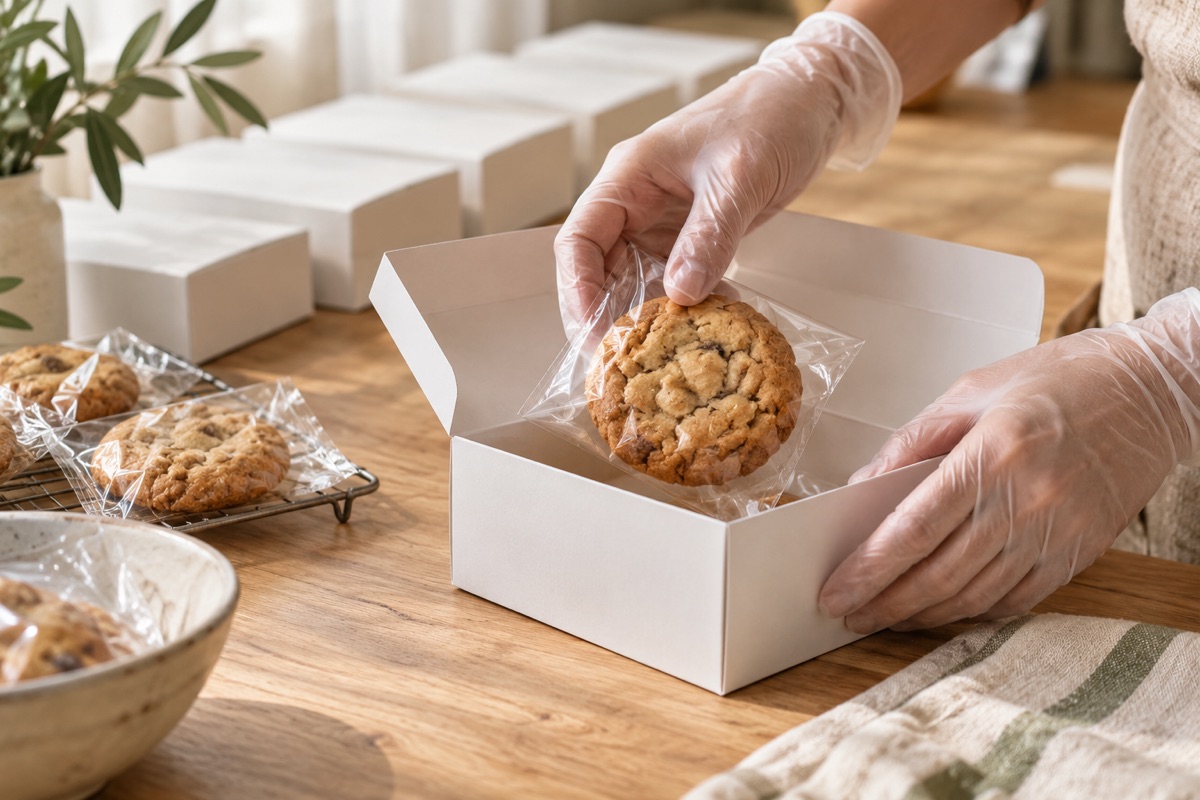
A single wrapped cookie is good for big cookies at a counter or a market. It protects against touching and scent transfer, but not against crushing in a bag.
A small bag of several cookies is light and simple. A bag protects from air and handling, not from crushing, so it suits sturdy cookies and short trips.
A rigid box with dividers or parchment holds the shape of delicate cookies and stacks well. It adds weight and bulk, which matters for mail. A tin is reusable and sturdy, but heavier.
For mail, the shipping carton around the box must hold the inner pack so nothing can move. Extension guidance on mailing baked goods says firm, crisp cookies travel best and soft or delicate ones are a poor fit for mailing, because soft baked goods are more prone to mold and fragile ones break.
Anything that touches the cookie is a food-contact material. Use materials sold for food use, and ask suppliers for documentation of food-contact suitability.
The food packaging brief is a good place to put your answers in a form you can hand to a supplier.
Testing samples
Treat packaging as something to test, not just to buy. Order or make small sample quantities before committing to a larger order, and run each through the real journey.
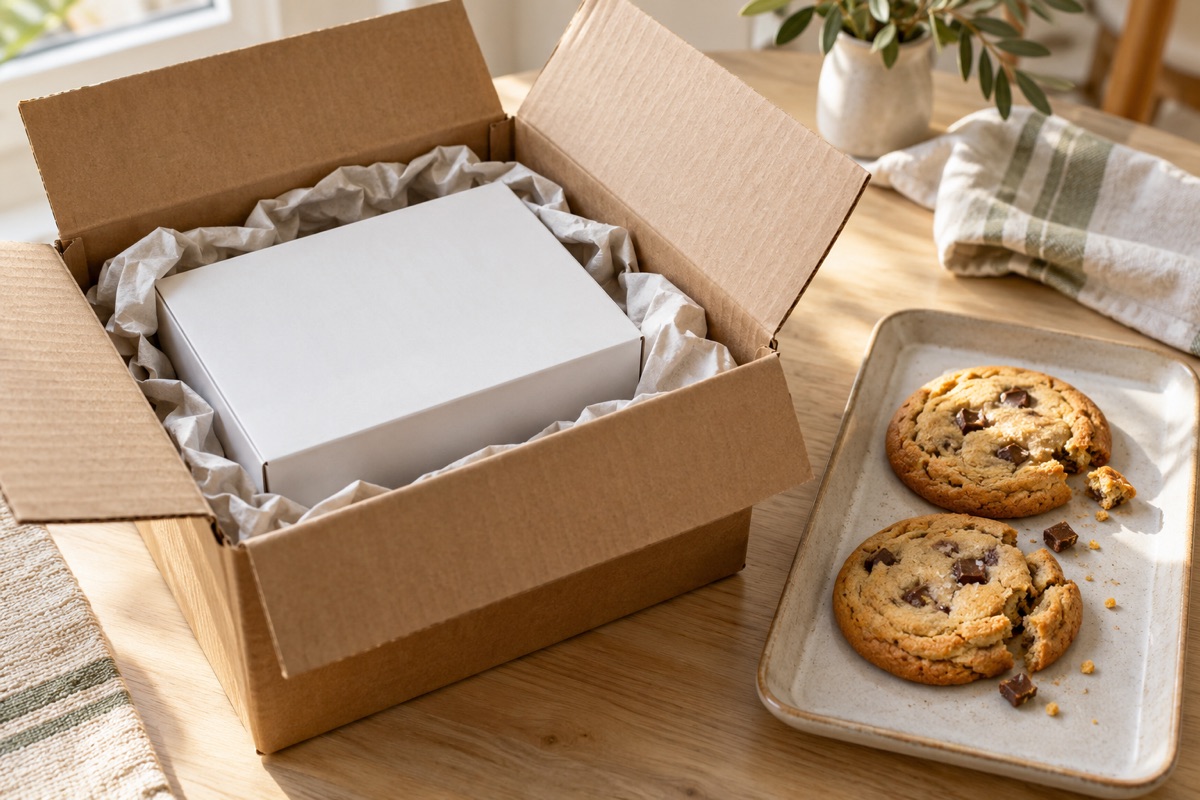
- Fit: pack the cookies exactly as you will on sale day, and check that the lid closes without pressing on them.
- Shake and drop: close the pack, shake it, and look for movement. Move it by hand along the route a customer would.
- Stack: put the pack where other packs will sit on it, and check for crushed cookies.
- Heat: if cookies contain chocolate or icing, leave a sample somewhere warm, such as a car in summer, and see how it behaves.
- Staleness: leave a sealed sample for the number of days you plan to sell it, then check how it feels. Texture is a quality check, not a safety test.
- Allergen and label check: read the label against the actual recipe, line by line.
Shelf life and food safety need proper validation. A cookie that looks and tastes fine on day three has not been proven safe or stable on day ten. How you establish a “best by” date depends on your product, your recipe and your location, so ask your state food program or a food scientist, and do not borrow a date from another product. For general storage behavior, see how to store cookies.
Cost assumptions
Packaging prices vary by supplier and change over time, so this article gives none. Write your own as assumptions: packaging per unit, labels per unit, shipping materials, and spoilage from breakage during testing. Then compare those against what you plan to charge. The cost calculator gives a structure for this, but the numbers are yours.
When to get professional help
Ask for help when you are unsure whether your state allows the sales channel you want, such as selling online, to shops or across state lines. Ask too if your cookie contains ingredients that need refrigeration, such as cream cheese filling, or you plan to claim anything about health or nutrition. A longer sales window needs a shelf-life determination, and a label that has to meet requirements you do not understand is another reason to get help.
Useful contacts: your state health or agriculture department, your state extension office, and a food scientist.
Next steps
- Look up your state’s cottage food or food business rules.
- Fill in the decision table above.
- Put the answers in the packaging brief template.
- Order a small number of sample packs, and run the tests.
- Estimate cost per unit with the cost calculator.
- Review the label against federal and state rules before the first sale.
Sources
- Guidance for Industry: Food Labeling Guide , U.S. Food and Drug Administration (accessed October 4, 2026) Federal summary of required label statements. The FDA does not pre-approve labels.
- Small Business Nutrition Labeling Exemption , U.S. Food and Drug Administration (accessed October 4, 2026) Describes federal exemptions from nutrition labeling and when a notice is needed.
- Food Allergies , U.S. Food and Drug Administration (accessed October 4, 2026) Lists the nine major food allergens in the United States.
- Cottage Food Business Law , University of Maryland Extension (accessed October 4, 2026) One state's cottage food and labeling rules, used here as an example of how state rules work.
- Can I safely ship homemade bread, brownies, cookies? , Ask Extension (Cooperative Extension) (accessed October 4, 2026) Which baked goods suit mailing and how to pack them.