
How to Steam and Eat a Whole Artichoke
How to trim, steam and eat a whole globe artichoke, with signs it is done, a simple dip, and a clear guide to which parts you eat and which you leave.
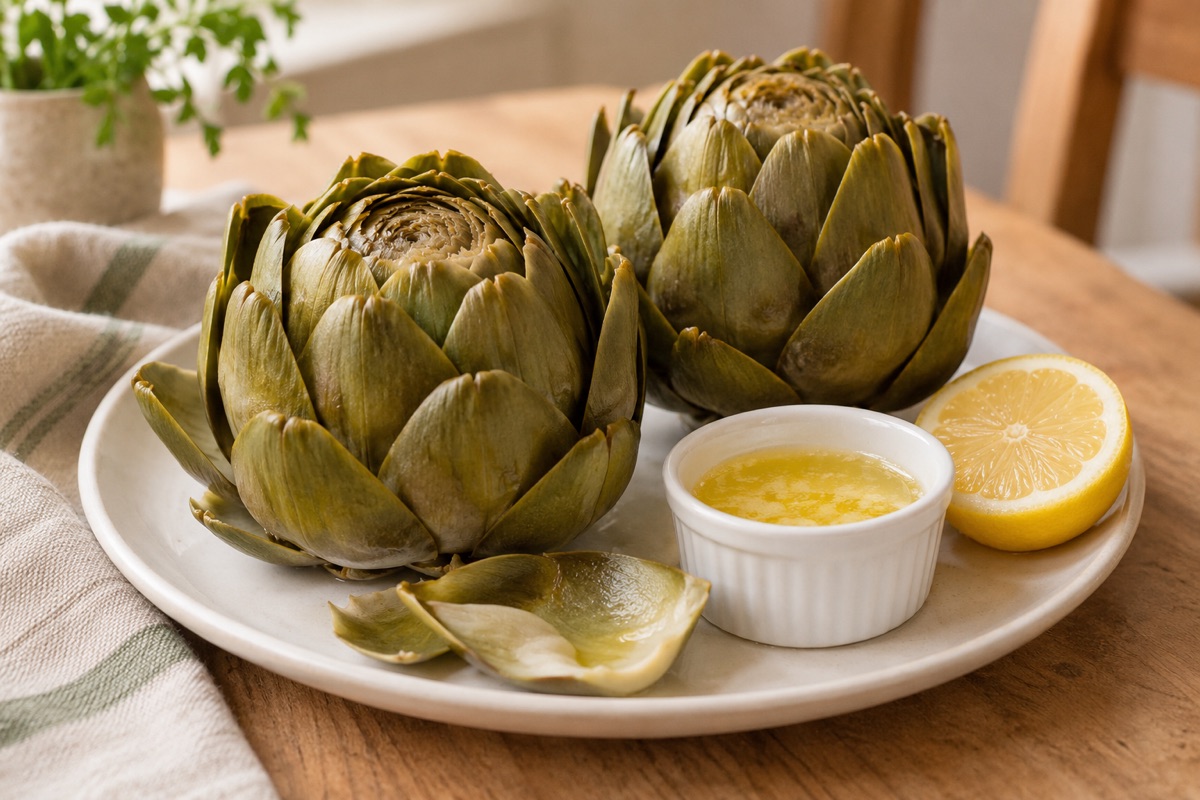
To steam a whole artichoke, trim the thorny leaf tips and the stem, then steam it upright in a covered pot until a center leaf pulls out easily and the base pierces with a knife. Eat it by pulling off each leaf, scraping the soft flesh from the base between your teeth, and then scooping out the fuzzy choke to reach the heart.
This guide covers the trimming, the cooking and the eating. If you are still choosing between types, read the guide to artichoke types, parts and buying forms first.
Ingredients
Two large globe artichokes serve two people as a first course or light side. Choose ones that feel heavy for their size, with tight, closed leaves. The rest is a lemon, salt, optional garlic and a dip.
A little lemon in the steaming water and on the cut surfaces helps limit browning. It is optional, and the artichoke tastes fine without it.
The recipe card has a dip of lemon juice and olive oil. Melted butter and mayonnaise are common too, but they add allergens (milk and eggs) to the dish.
Why these steps work
The upper leaf tips can be sharp, so snipping them makes the artichoke easier to handle and eat. Trimming the stem gives a flat base, so the artichoke stands in the pot and steam reaches the heart evenly.
Steaming keeps the leaves out of the water, so the artichoke doesn’t get waterlogged. A tight lid keeps the steam in. Cut surfaces turn brown quickly in air, and lemon juice slows that, though the color is cosmetic.
Step-by-step method
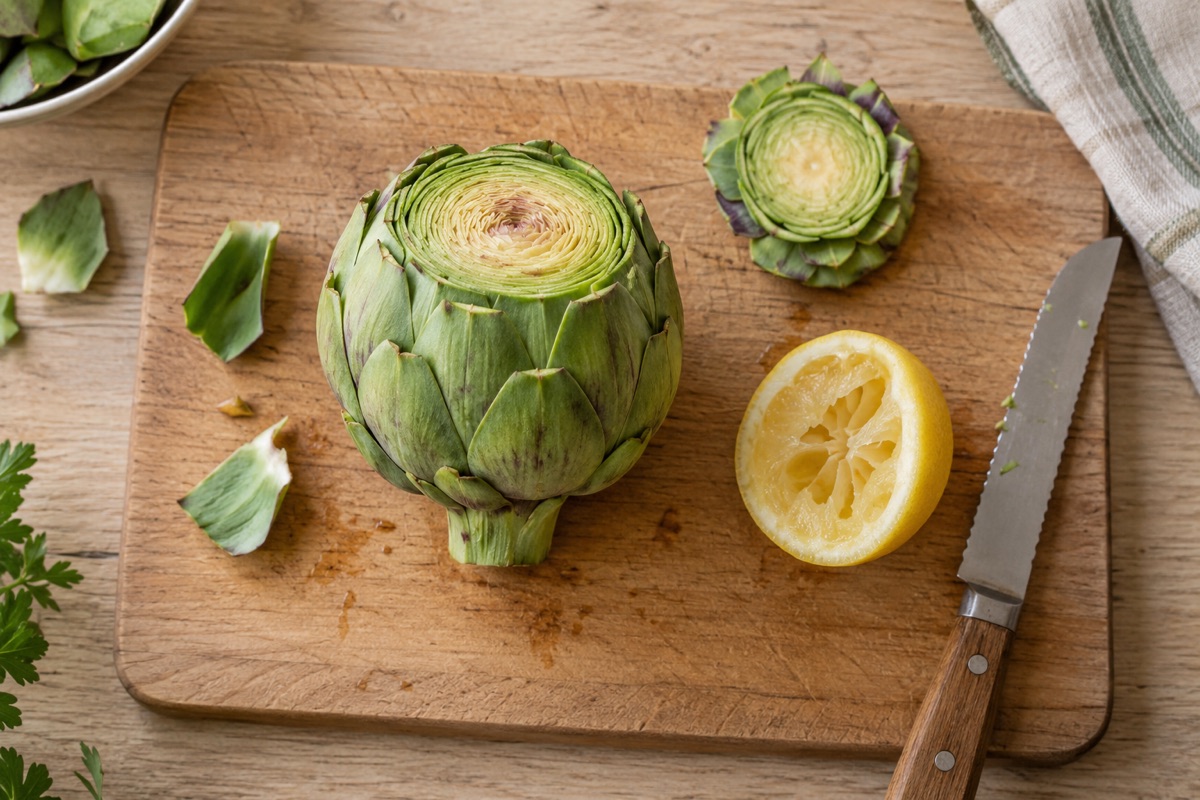
- Hold each artichoke under cold water and gently spread the leaves.
- Pull off the small, tough leaves near the stem.
- Cut the stem short so the artichoke stands, and cut about 1 inch (2.5 cm) off the top. Snip the pointed tips from the remaining leaves with scissors.
- Rub the cut surfaces with a lemon half.
- Put the water, salt, garlic and a squeezed lemon half in a pot with a steamer basket. Bring it to a boil.
- Place the artichokes stem side down, cover tightly and steam over medium heat. Check the water level partway through and top up with hot water if needed.
- Start testing at 25 minutes for medium artichokes, later for larger ones, which can take noticeably longer. A done artichoke has a center leaf that pulls away with little resistance and a base that a knife slides into easily.
- Lift them out and let them drain upside down briefly.
How to tell it is done
Color alone is not a reliable guide. A steamed artichoke turns from bright green to olive green, but the leaf-pull and base-pierce tests tell you more. If the leaf resists, steam a few minutes longer and test again.
How to eat a whole artichoke
The artichoke is built in layers, and you eat it from the outside in.
- Pull off an outer leaf and hold it by the tip.
- Dip the pale, fleshy base in the sauce. That end is the edible part.
- Draw the leaf through your teeth to take the soft flesh, and discard the rest of the leaf.
- Work inward. The leaves get thinner and more tender as you go. The thin leaves covering the choke are edible, while the fibrous upper part of each leaf is usually discarded.
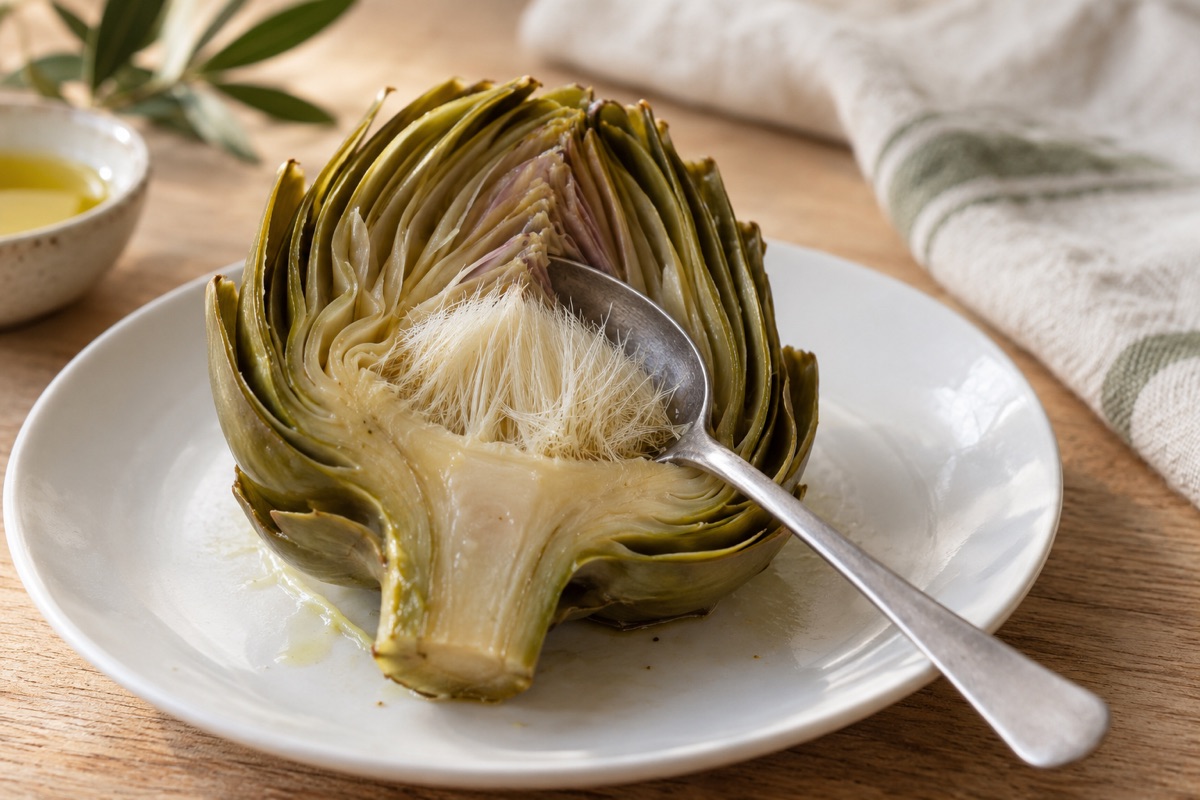
- When the leaves are gone, you will see a fuzzy mass over the heart. Scoop it away with a spoon and discard it.
- Cut the heart, the meaty base, into pieces and dip them. If you left the stem on, some of it is also tender once peeled.
So you eat the fleshy leaf bases, the thin leaves over the choke, the heart and a bit of the stem. You leave the fibrous leaf tops and the fuzzy choke.
Variations
These are options for the cooking liquid and dip, not tested results.
- Add a bay leaf or thyme sprig to the steaming water.
- Dip in melted butter, a garlic and olive oil mixture, or a yogurt-based dip. Each changes the allergens.
- Halving the artichoke lengthwise and removing the choke before cooking can shorten the steaming time. Check doneness the same way.
- A pressure cooker or microwave also works, but times vary with the appliance. Follow the manual and use the same doneness checks.
For the seasonal side of cooking with artichokes, see this note on cooking with the seasons.
Storage and reheating
Refrigerate leftover artichokes within 2 hours of cooking (1 hour if the temperature is above 90°F), in a covered container. USDA says leftovers can be kept in the refrigerator for 3 to 4 days. If you reheat them, bring them to 165°F as measured with a food thermometer. Many cooks eat leftover artichokes cold, with the dip.
Do not use looks or smell as a safety test. If you are unsure how long the artichoke has been held, throw it out.
How to Steam and Eat a Whole Artichoke
This recipe card has not been marked as tested yet.
- Yield
- 2 servings (1 artichoke each)
- Prep
- 15 min
- Cook
- 40 min
- Total
- 55 min
Ingredients
- 2 large globe artichokes (about 340 g / 12 oz each)
- 1 lemon, halved
- 475 g (2 cups) water for the steamer pot
- 3 g (1/2 teaspoon) fine salt
- 2 cloves garlic, smashed (about 6 g), optional
- 30 g (2 tablespoons) extra-virgin olive oil, for the dip
- 15 g (1 tablespoon) lemon juice, for the dip
- Pinch of salt and black pepper, for the dip
Method
- Rinse the artichokes under cold water and spread the leaves slightly to let water run through.
- Pull off the small tough leaves around the base. Trim the stem so the artichoke sits upright.
- Cut about 1 inch (2.5 cm) off the top. Snip the thorny tip from each remaining leaf with kitchen scissors.
- Rub all cut surfaces with a lemon half to slow browning.
- Add the water, salt, garlic and a squeezed lemon half to a pot with a steamer basket. Bring to a boil.
- Set the artichokes in the basket stem side down. Cover tightly and steam over medium heat, adding hot water if the pot runs low.
- Start testing at 25 minutes. Pull a center leaf: it should release easily and the base should pierce easily with a knife.
- Lift out the artichokes and drain them upside down for a minute.
- Whisk the olive oil, lemon juice, salt and pepper for the dip. Serve alongside.
Steaming time depends on size and age of the artichoke, so rely on the doneness tests, not the clock. Standard method, not tested by our team. If you use melted butter or mayonnaise for dipping, add milk or eggs to the allergen list.
Sources
- Artichoke - Wikipedia , Wikipedia (accessed October 4, 2026)
- Leftovers and Food Safety | Food Safety and Inspection Service , USDA Food Safety and Inspection Service (accessed October 4, 2026)