
How to Preserve Family Recipes Without Losing the Stories
A step-by-step workflow for collecting, transcribing, scanning and backing up family recipes, with the context that makes them worth keeping.
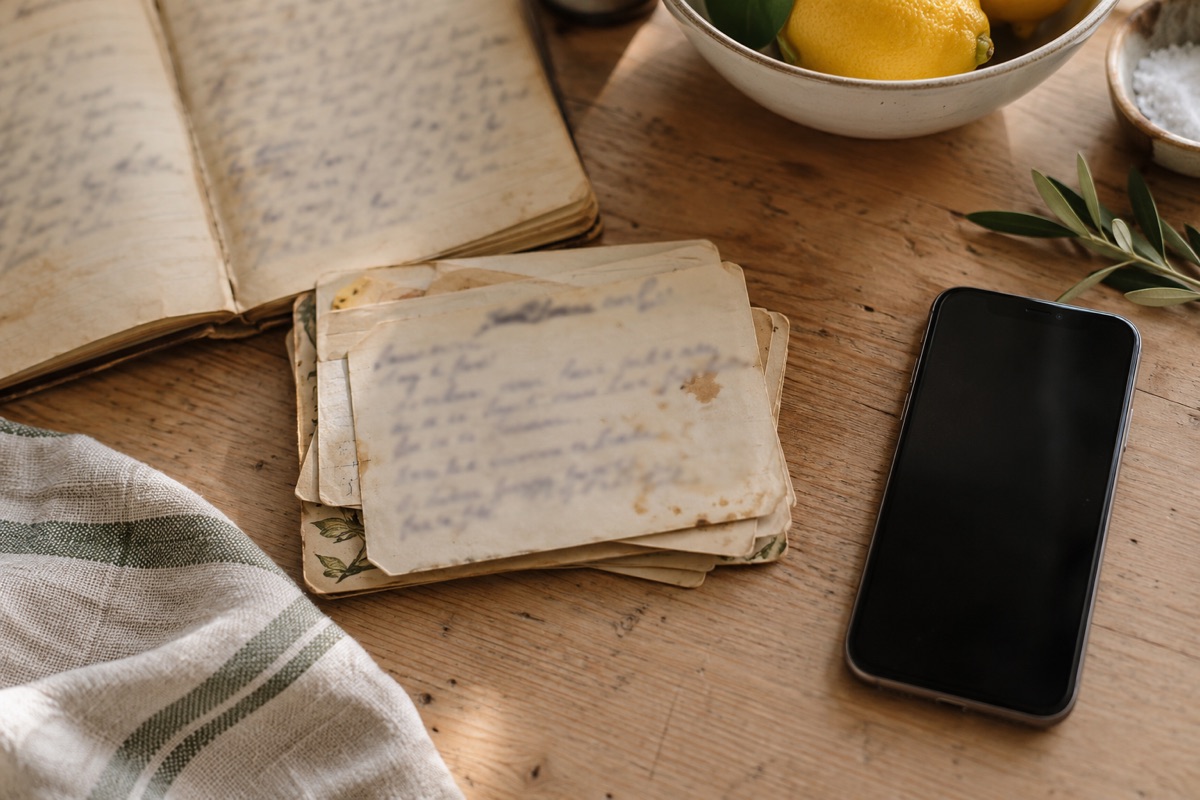
To preserve a family recipe, gather the original, record who wrote it and what you know about it, transcribe it exactly, scan or photograph it, name and back up the files, and ask before you share. Do these in that order. The recipe is the easy part to save. The context around it disappears first.
This guide covers preservation: getting recipes out of drawers and onto a screen. If you want to turn them into something to give away, see how to make a family recipe book afterward.
Collect the originals
Index cards, margin notes in cookbooks, envelopes with a quantity scribbled on the back, clipped magazine pages and screenshots on someone’s phone all count as recipes. Find every form they take.
Ask relatives what they have before you ask what they remember. People often say they have nothing, then remember a shoebox. When you borrow something, write down what you took and when you will return it.
Keep each original together with anything attached to it, such as a note, a photo or a clipping. Do not staple, tape or trim to make things neat.
Record who, what, where and when
A recipe without a source is just instructions, so make a short record for each one before you do anything else. The National Archives recommends basic file metadata covering who, what, where and when, and the same four questions work for recipes. Who wrote it, and who is it from if that is someone else? What is it called, and is the title the one on the card or one you added? Where did it come from: a family kitchen, a church cookbook, a package label? When is it from, even roughly? Mark guesses as guesses.
Add a line for anything the card does not say, such as an occasion, a substitution the cook always made, or what the dish was served with. Write down whose memory each detail comes from. Keep your own notes separate from the original’s wording so nobody later mistakes your comment for the author’s.
If someone is willing to talk, record them or take notes while they cook from the card. Get their agreement first, and say what you plan to do with the recording.
Transcribe without losing context
A typed copy is easier to read, search and scale, but it should not replace the original. Transcribe in two layers.
- Faithful copy. Type exactly what the card says, including odd spelling, vague amounts like “a lump of butter” and abbreviations. Put anything you cannot read in brackets, for example [unclear].
- Cook’s notes. In a separate section, add modern measures, oven temperatures or clarifications, each marked as your addition.
Do not correct or complete a recipe in the faithful copy. Missing steps and unusual quantities are part of the record. If you want to adapt a recipe so it works reliably today, do that in the notes layer and keep the original wording intact.
Once the copy is typed, cook from it. A simple recipe such as wacky cake is a good one to try first, because gaps in the instructions show up quickly. Note anything the card assumed you already knew in the cook’s notes.
Scan or photograph each item
Digitizing lets you view and share items without handling them, which can damage them. The National Archives also says to keep your originals after digitizing, because digital files have their own preservation risks and can be lost.
Wash and dry your hands first and use a clean, clear surface. The National Archives says paper can be handled without gloves, but photographs should be handled with gloves.
Make sure a flat original fits completely on the scanner glass, since a lid can crush or crease paper that sticks out. Do not use an automatic document feeder for fragile, bent or valuable paper, because it can jam and tear it. For a bound notebook or cookbook, use a copy stand with supports rather than forcing it flat on a scanner.
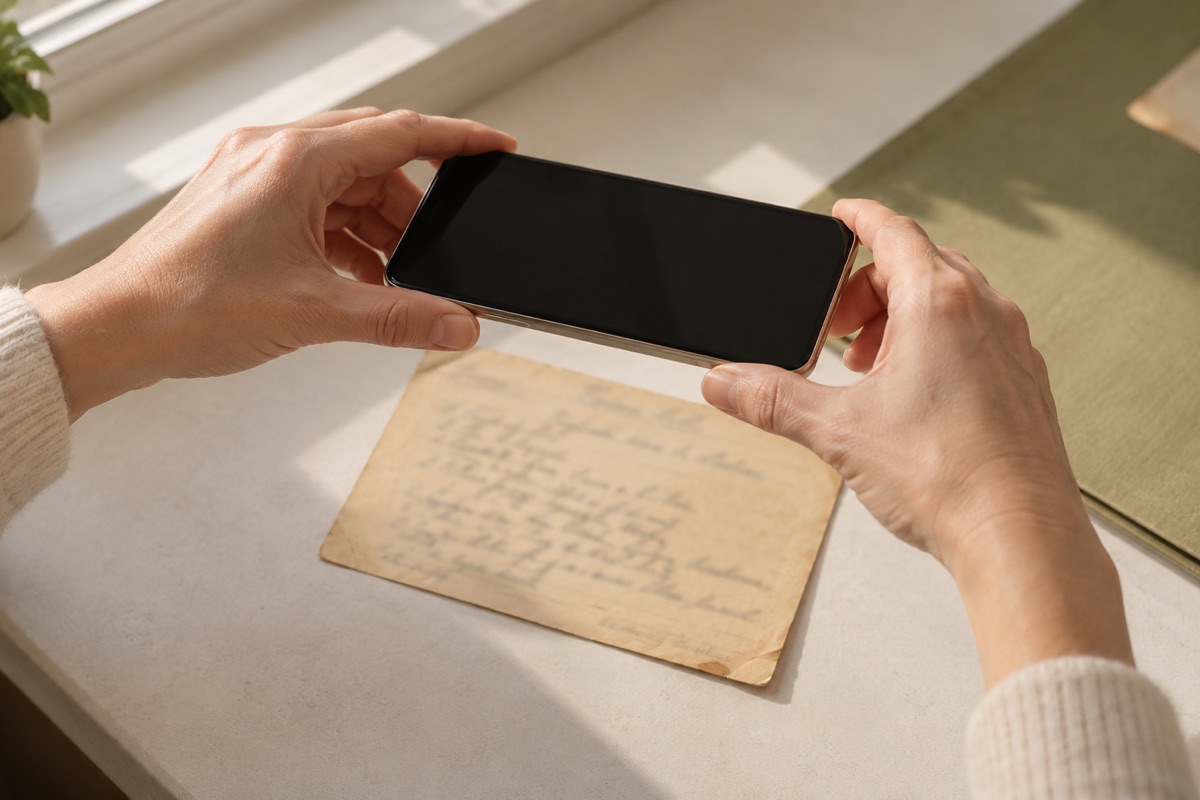
If you use a phone, photograph the item flat, in even daylight, straight above, without shadows from your hands. Capture the back too if it has writing. Scan stained or marked cards as they are. Stains and splatters show a recipe was used.
Name, save and back up the files
Good file names make old recipes findable years later. The National Archives advises plain Latin letters and numbers, with hyphens or underscores instead of spaces, and no punctuation or symbols.
A simple pattern is recipe-title_source-person_year_front.jpg, such as apple-cake_grandmother-smith_circa-1960_front.jpg. Use whatever order suits you, but use it every time. These names are placeholders, not real recipes.
Save in layers so nothing is overwritten:
- Originals: the untouched scans or photos. Never edit these.
- Working copies: cropped or straightened images.
- Transcripts: the faithful copy and the cook’s notes, as separate files or clearly separate sections.
Keep a version label in the file name or a short change log, for example “v2, added oven temperature note.” That way you can always see what the author wrote and what you added.
For backups, the National Archives recommends the 3-2-1 rule: three copies, stored on two different media, with one copy kept off-site. A cloud folder or a drive at a relative’s house can serve as the off-site copy. Check every so often that the files still open.
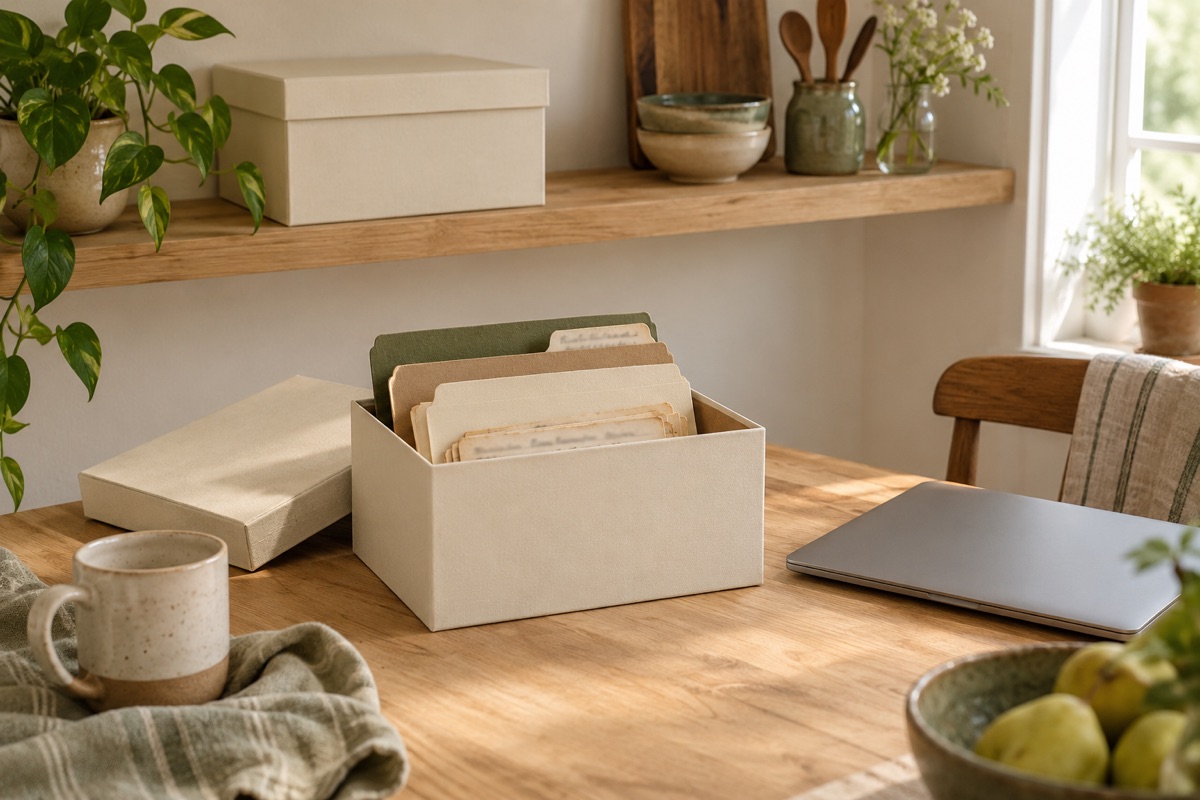
Store paper originals the way the National Archives describes: away from damp basements, garages and hot attics, and kept cool and dry in containers large enough that nothing has to be folded.
Share with permission
Before you pass anything on, ask the people involved. Share a recipe within the family if the author or relatives are comfortable with it, and ask the author or their heirs first if you plan to publish more widely. For photos, check who took the picture and whether the people in it would be comfortable with it being shared. Share someone’s words and stories only with their agreement, and let them correct details first.
A recipe clipped from a cookbook or magazine may be under someone else’s copyright. Keep it in the archive, and do not republish it without permission.
Record the permission itself. A line in your notes such as “Okay to share with the family, not online” is enough.
What to avoid
- Throwing out originals after scanning.
- Retyping a recipe from memory and treating it as the original.
- Inventing a backstory to fill a gap. Say “source unknown.”
- Storing your only copy of the files on one phone or laptop.
- Posting a relative’s recipe, photo or story online before asking.
Once your files are in order, how to write recipe headnotes shows how to turn the context you collected into a short introduction for each recipe.
Sources
- Digitizing Family Papers and Photographs , U.S. National Archives (accessed October 4, 2026)
- Storing Family Papers and Photographs , U.S. National Archives (accessed October 4, 2026)
- Tips for Handling Family Papers and Photographs , U.S. National Archives (accessed October 4, 2026)