
How to Store Homemade Bread Without Guesswork
Match the storage to the loaf. Crusty bread, sandwich bread and quick breads each keep best in different wrapping, and the freezer is the answer for what you will not finish.
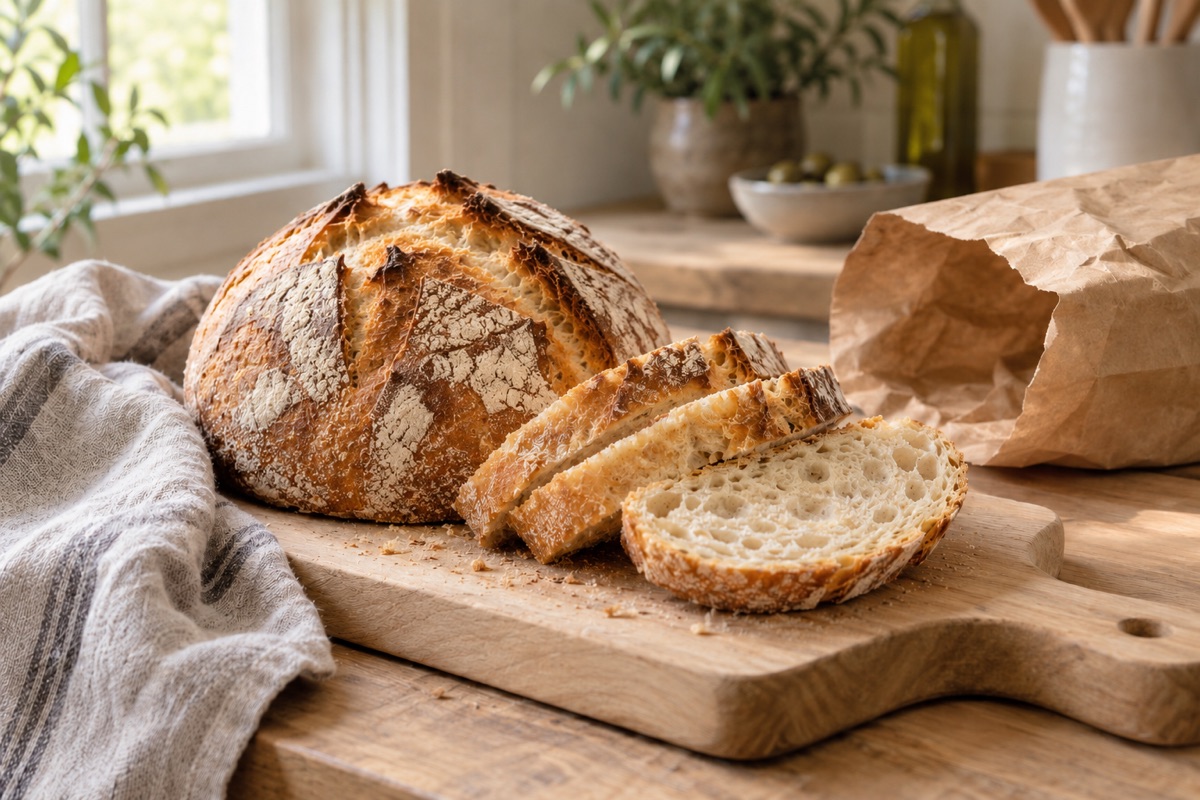
Homemade bread keeps best when it is cooled completely, then stored in a way that suits its crust. Crusty loaves do better with paper or a cloth, soft sandwich loaves with a bag, and anything you will not finish within a couple of days belongs in the freezer, sliced if you like.
This guide applies to readers in the United States and was last checked against extension sources on October 4, 2026. Official guidance covers freezing in detail but gives no counter or refrigerator timeline for homemade bread, so this guide does not invent one.
Which bread you have
Storage depends on what the crumb and crust are like.
- Crusty, lean loaves (no-knead, sourdough, baguettes) have a crisp crust that softens in a sealed bag. They are at their best on the first day and are stored for texture, not just freshness.
- Soft, enriched breads (sandwich loaves, rolls, brioche) have a tender crust and a moist crumb that stays soft in a bag.
- Quick breads and muffins (banana bread, cornbread) are moist and often contain fruit, nuts or dairy. They behave more like cake.
- Breads with perishable add-ins (cheese, meat, fresh vegetables) need refrigeration for those ingredients. Follow official refrigerator guidance for them and the guidance linked in the food safety note below.
Stale bread is not a failure. A day-old crusty loaf is useful in dishes such as tomato bread soup.
Steps
- Cool the loaf completely. K-State Extension says to cool yeast breads and rolls completely before wrapping for the freezer, and to cool quick breads completely and wrap them well. The same applies to counter storage, because trapped steam softens the crust and makes the crumb damp.
- Cut only what you need. An uncut loaf keeps its crumb protected, and many home bakers store a cut loaf cut side down on a board.
- Choose the wrap by loaf type (below).
- If you will not finish the loaf in a couple of days, slice and freeze the rest early.
- Label the date and the type. The National Center for Home Food Preservation lists the product name, packaging date and form of the food, such as whole or sliced, as the basics of a label.
Wrapping by bread type
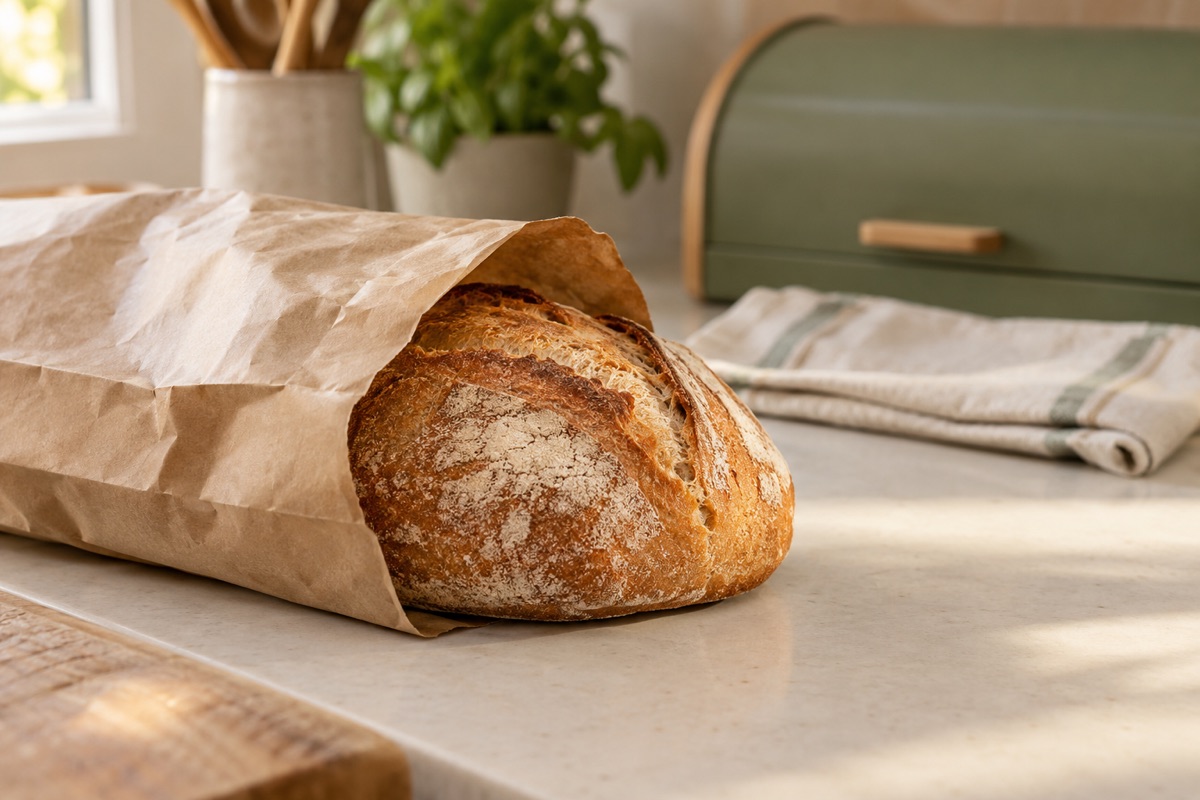
A paper bag, a clean cotton or linen cloth, or a bread box lets some air move around a crusty loaf so the crust does not soften as fast. The trade-off is that the crumb dries out sooner. Plastic keeps the crumb soft but softens the crust, so the choice depends on whether you value the crust or the softness, and how soon you will eat the loaf.
Soft sandwich loaves and rolls do better in a plastic bag or a closed container, which holds in moisture and keeps the crumb soft. Press out the air and close it well. Quick breads should be wrapped tightly in plastic wrap or foil, or stored in an airtight container. Fruit and nut breads are easier to slice neatly when they have cooled fully.
Refrigerators are not usually the best place for plain bread. A general reference on staling (Wikipedia, so treat it as a secondary source) says bread stales most rapidly at temperatures just above freezing, that bread stored in a refrigerator stales faster, and that refrigeration can slow mold growth. So the fridge trades softness for mold protection, which can make sense in a humid, warm kitchen or for breads with perishable fillings. If you do refrigerate, wrap it well and expect to reheat or toast slices.
Staling alone does not make bread unsafe, but mold can. USDA FSIS says you only see part of the mold on the surface, and that when a food shows heavy mold growth, “root” threads have invaded it deeply. Texture is not a safety test, so if you see mold on bread, discard the loaf rather than cutting off the spot. If you are unsure whether something is safe, throw it out.
Freezing bread
The freezer is the method with real official guidance behind it. K-State Extension says yeast breads and rolls should be cooled completely and not frosted or decorated before freezing. It gives a quality guideline of 6 to 8 months for yeast bread and rolls and 2 to 4 months for quick breads, muffins and coffee cakes. Those figures describe flavor and freshness, are from one extension handout and are not safety limits. K-State Extension gives 0°F or lower as the freezer temperature.
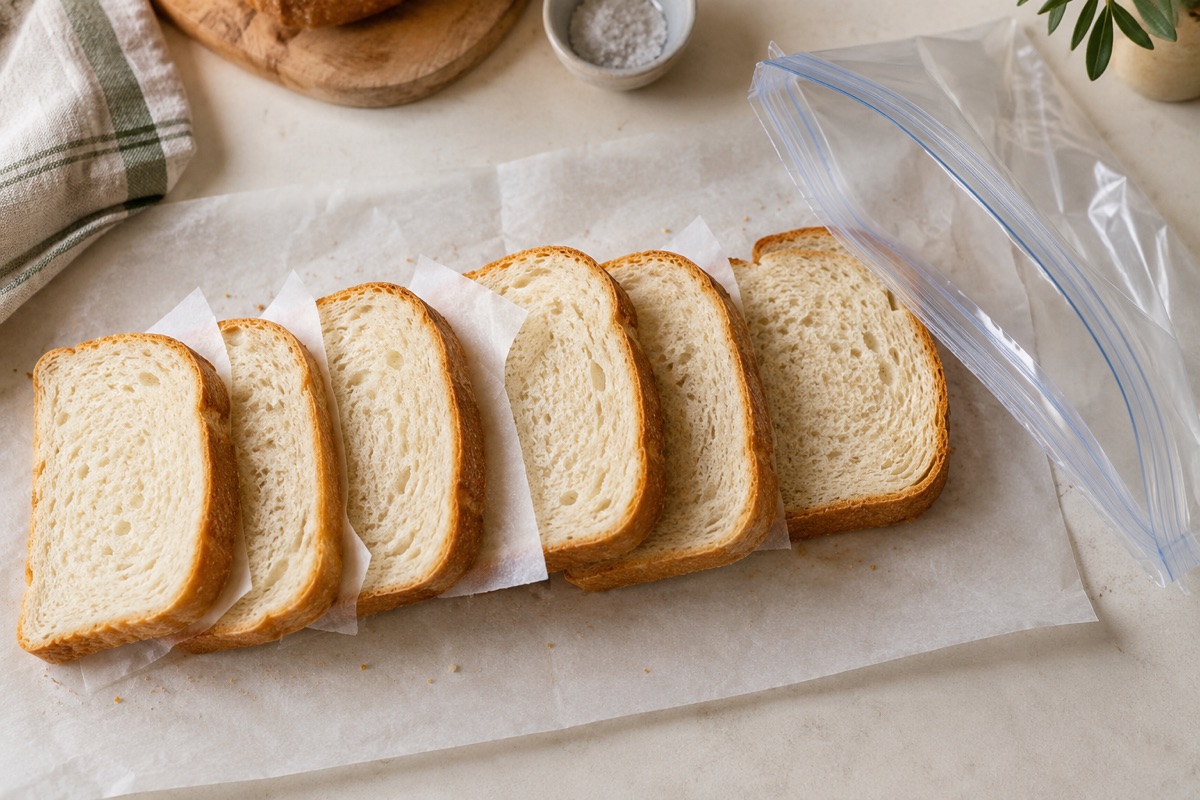
Wrap the bread tightly in freezer-weight wrap, foil or a freezer bag. The National Center for Home Food Preservation lists plastic freezer bags, plastic freezer wrap, freezer paper and heavy-weight aluminum foil as suitable flexible packaging, and says to press out as much air as possible before sealing. The same source lists breads among the foods that do not need headspace for expansion.
If you use a little at a time, slice first and put a square of parchment between slices so you can pull out one at a time. For long storage, add a second layer: a freezer bag around a wrapped loaf, or a rigid container for loaves you want protected from being crushed. The approach in how to freeze chocolate cake applies to bread too. Label with the date, and use older loaves first.
If you are deciding between a tight container and vacuum sealing for a loaf, see airtight versus vacuum-sealed storage. Soft bread can compress under vacuum, so check how it affects the crumb before relying on it.
Thawing and reheating
K-State Extension says to unwrap yeast bread slightly and let it thaw at room temperature for 2 to 3 hours, then serve it at room temperature or reheat it wrapped in foil at 350°F for 15 to 20 minutes. For quick breads, thaw them wrapped at room temperature, and slice fruit and nut breads while they are partially frozen to prevent crumbling.
Slices can often go straight from the freezer to the toaster. Follow the label for any bought or par-baked loaf.
Official thawing advice from USDA and FoodSafety.gov is written for perishable foods. For plain bread, room-temperature thawing is the extension guidance quoted above. For bread with perishable fillings, such as cheese or meat, thaw in the refrigerator and check the official guidance linked in the food safety note below.
Common questions
Is bread stale or spoiled? Stale bread is dry or firm but otherwise normal. Spoiled bread shows mold or smells wrong. Staling is a texture problem, and mold is a safety problem. Texture alone never tells you a food is safe.
Can I refreeze thawed bread? This guide does not cover refreezing, because the sources reviewed do not address it for bread. Freezing in small portions avoids the question.
How long does homemade bread last on the counter? No official source reviewed gives a figure for homemade bread. Eat it while it is soft and normal, freeze what you will not finish, and discard any with mold.
Should I follow my recipe or this guide? If a recipe or product label gives storage directions, follow them first.
Official guidance and review date
Reviewed October 4, 2026 for the United States. Freezer guidance comes from K-State Research and Extension and the National Center for Home Food Preservation at the University of Georgia; mold guidance comes from USDA FSIS. The food safety note below links to FoodSafety.gov for refrigerator and freezer charts. Counter-storage advice here is general guidance and not an official time limit.
Official guidance and sources
Sources last checked October 4, 2026.
- Freezing Baked Goods , K-State Research and Extension, Ellis County (accessed October 4, 2026) Cooling, wrapping, thawing, reheating and quality-based freezer guidelines for yeast breads and quick breads.
- Packaging and Labeling Foods , National Center for Home Food Preservation, University of Georgia (accessed October 4, 2026)
- Containers for Freezing , National Center for Home Food Preservation, University of Georgia (accessed October 4, 2026)
- Staling , Wikipedia (accessed October 4, 2026) General reference for why bread stales and how refrigeration affects staling and mold; secondary source.
- Molds on Food: Are They Dangerous? , USDA Food Safety and Inspection Service (accessed October 4, 2026)