
Meyer Lemon Pudding Cake with a Soft Center
A Meyer lemon pudding cake that bakes into a light sponge on top and a soft lemon sauce underneath, with clear signs for judging doneness.
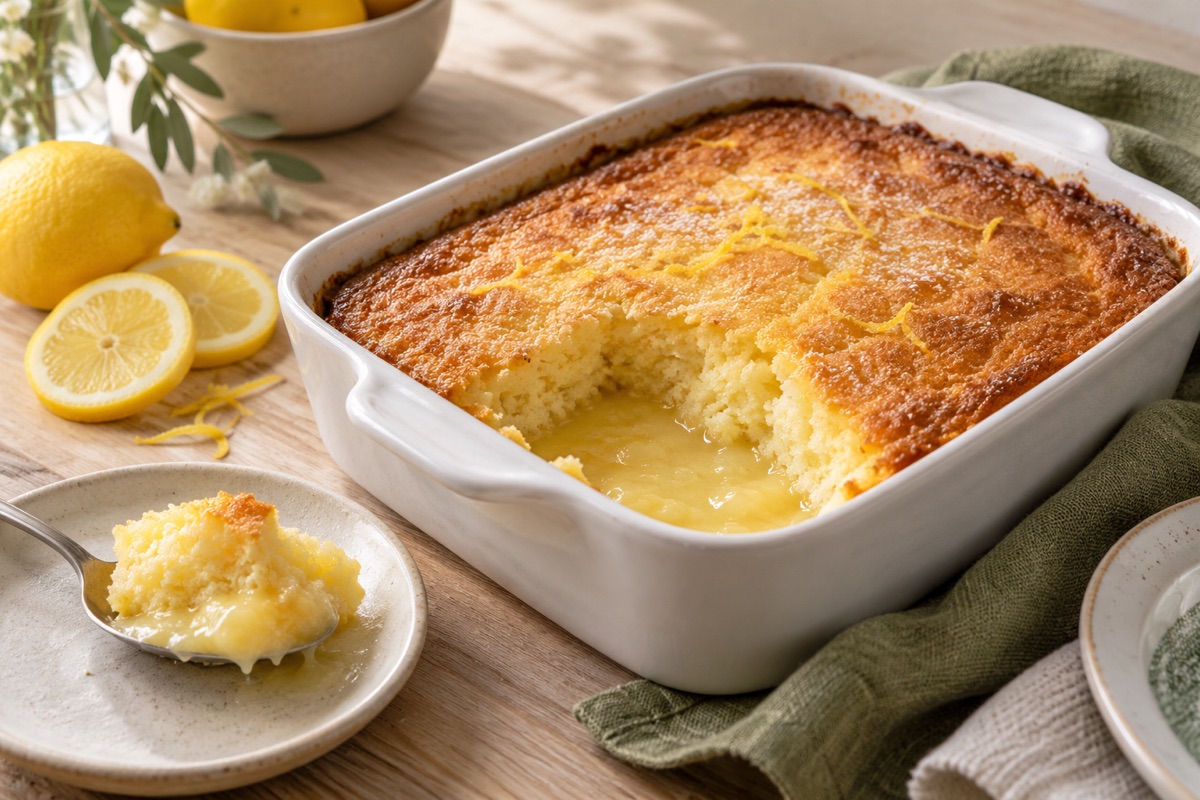
A pudding cake is a single batter that separates as it bakes: a light sponge rises to the top and a soft lemon sauce settles at the bottom. This version uses Meyer lemon juice and zest, a thin batter of milk, egg yolks and a little flour, and whipped egg whites folded in at the end. You serve it warm or lukewarm from the dish, scooping down through both layers.
Ingredients
The full list with grams and US measures is in the recipe card. A few notes on the ingredients that matter most.
You need about 80 ml (1/3 cup) of Meyer lemon juice and a tablespoon of zest. Meyer lemons are usually milder and more floral than regular lemons. For how they differ in the kitchen, see Meyer lemons vs regular lemons.
Separate the eggs while cold, because yolks and whites separate more cleanly that way, then let them come to room temperature before whipping. Whole milk gives a richer sauce, and it shouldn’t be fridge-cold when you add it, so the batter stays smooth. The flour is only a small amount. It thickens the lower layer into a sauce rather than building a full cake crumb.
Why these ingredients work
The batter is thin because it holds a lot of milk and lemon juice and very little flour. When it bakes, the whipped egg whites float up and set into a sponge. The heavier mixture of liquid and yolk stays underneath, where it thickens gently into a custard-like sauce.
A water bath protects that sauce. Water around the dish keeps the edges and bottom from getting too hot too fast, which helps the sauce stay smooth instead of curdling or drying out.
Lemon juice adds acid and flavor. Zest adds aromatic oils without more liquid, so grate it directly into the sugar or yolks.
Step-by-step method
- Heat the oven and start heating water. Butter the dish and set it in a larger roasting pan that will hold the water bath.
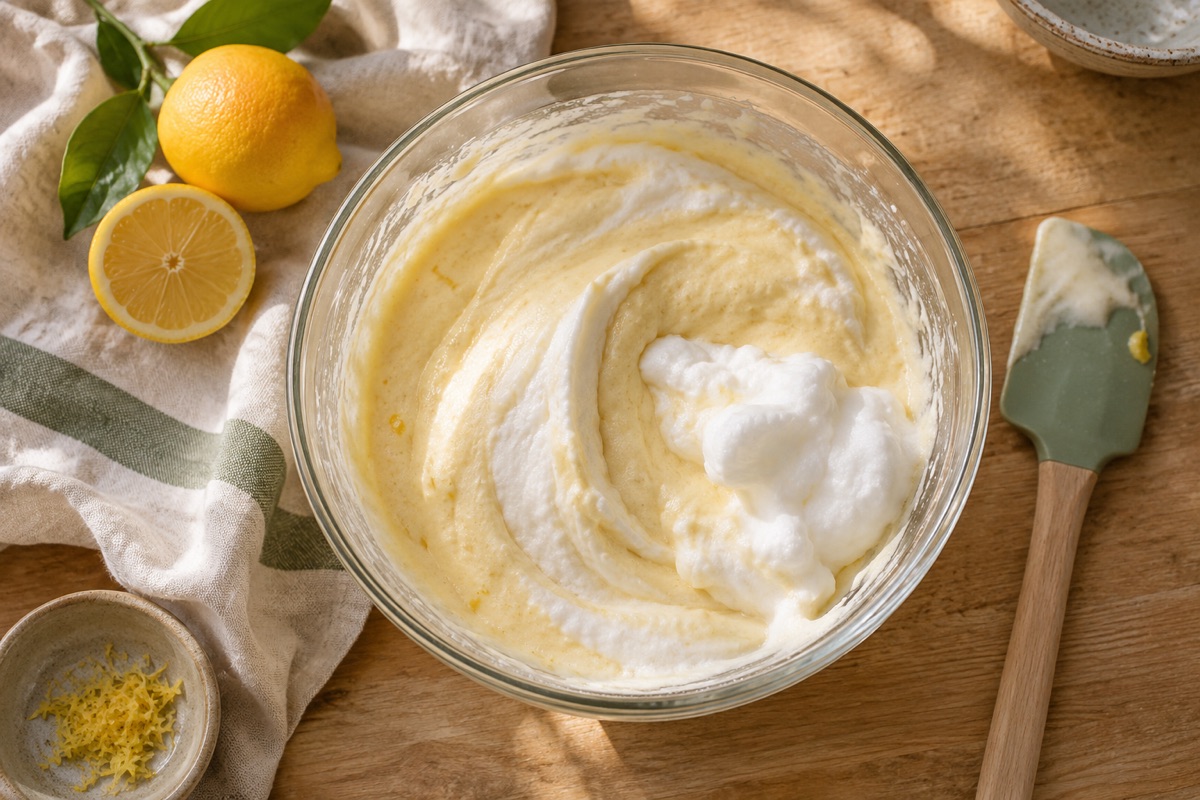
- Whisk the yolks, butter, sugar, flour, salt and zest until combined, then whisk in the lemon juice and milk. The batter looks thin and a little curdled at first, which is normal because of the acid in the juice.
- Beat the whites in a clean, dry bowl until they hold soft to medium peaks. Stop before they look dry or clumpy.
- Add the whites in two additions, folding with a spatula and keeping as much air as you can. A few small streaks are fine.
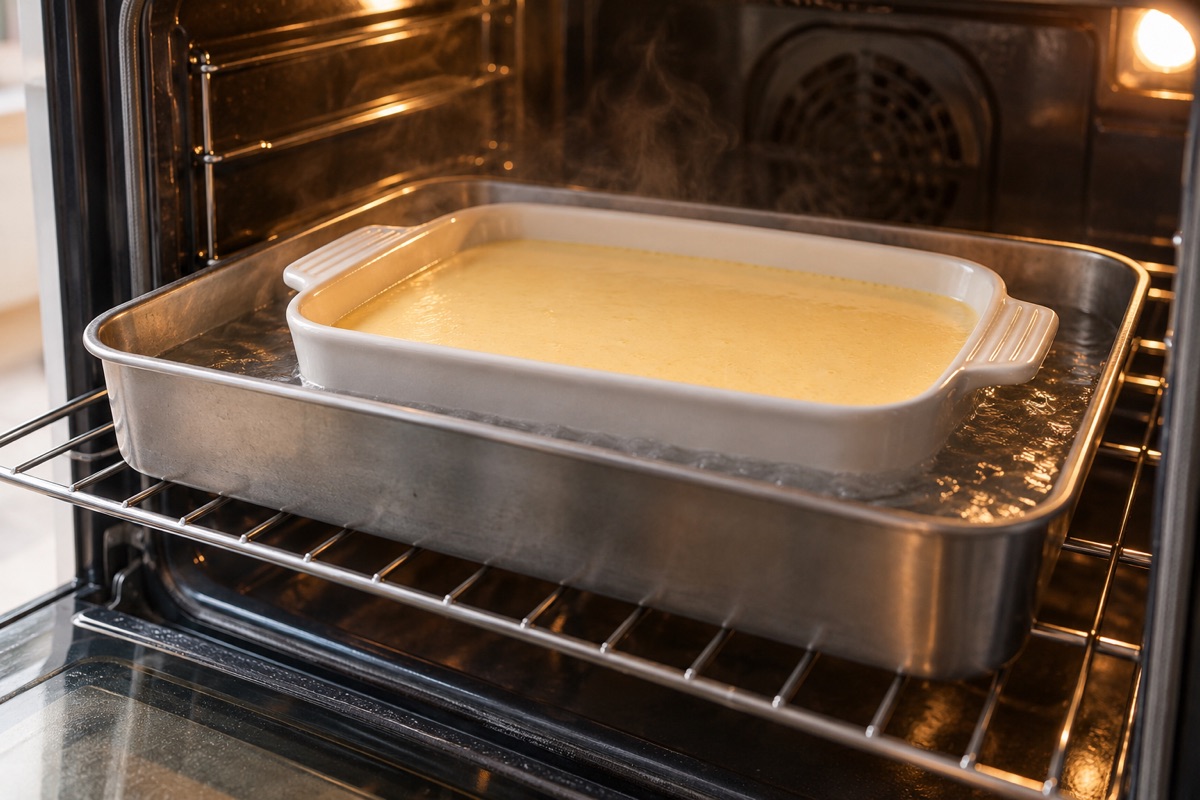
- Pour the batter into the dish, place the pan on the oven rack, then pour hot water around the dish until it comes about halfway up the sides.
Setting up the water bath
Pour the hot water in after the dish is already on the oven rack, so you don’t have to carry a full pan across the kitchen. The water should come about halfway up the dish. Don’t let it splash into the batter.
How to tell when it is done
A toothpick or skewer test doesn’t work here, because the lower layer is meant to be soft and saucy. Look for these signs instead:
- The top is set. Touched lightly near the edge, it feels firm and springs back instead of leaving a wet dent.
- The surface is lightly golden, with some color rather than a pale, glossy top.
- The center barely moves. Nudge the dish gently. A small, slow wobble in the middle is expected, like a set custard. A wave of liquid moving across the surface means it needs more time.
- The edges have pulled slightly away from the sides of the dish.
If the top is browning fast before the center sets, tent it loosely with foil. If the sauce looks separated or watery after cooling, it may have been underbaked or taken out too soon. Timing varies with the oven, the dish material and its depth, so rely on these cues rather than a single time.
Let the dish cool in the water bath for a few minutes, then lift it out. Waiting at least twenty minutes lets the sauce thicken a little before you scoop.
Variations
These are options, not tested results.
- With regular lemons, use the same quantity of juice and zest. The flavor is sharper, so taste the batter and add a little more sugar if you prefer.
- For individual servings, divide the batter among oven-safe ramekins in the water bath. The doneness cues are the same: set top, slight wobble.
- Dust with powdered sugar, or serve with berries or lightly whipped cream.
- Replace part of the lemon juice with lime juice for a sharper edge.
Storage and reheating
Serve it the day it is made if you can, since the sponge and sauce are best freshly baked and still warm or at room temperature. Because the cake contains eggs and milk, handle leftovers with care.
The University of Illinois Extension advises refrigerating or freezing leftovers within two hours of serving, using refrigerated leftovers within 3 to 4 days, and reheating leftovers to at least 165°F. USDA FSIS gives the same guidance. A soft, saucy dessert like this won’t hold its two-layer texture after chilling and reheating as well as it did fresh, so expect the sauce to firm up when cold.
Pudding cakes with a soft center are not ideal for freezing. If you want to freeze a sturdier cake, our guide on how to freeze chocolate cake and wrap it well covers the wrapping method. For a simpler dessert that stores more easily, see the wacky cake recipe.
Recipe card
The recipe card on this page lists the yield, times, ingredients with metric and US measures, steps and allergens. This recipe is a standard formulation and is not marked as kitchen-verified.
Meyer Lemon Pudding Cake with a Soft Center
This recipe card has not been marked as tested yet.
- Yield
- Serves 6
- Prep
- 25 min
- Cook
- 40 min
- Total
- 1 hr 5 min
Ingredients
- 28 g (2 tablespoons) unsalted butter, melted, plus extra for the dish
- 150 g (3/4 cup) granulated sugar
- 30 g (1/4 cup) all-purpose flour
- 1.5 g (1/4 teaspoon) fine salt
- 3 large eggs, separated, at room temperature
- 6 g (1 tablespoon) finely grated Meyer lemon zest
- 80 ml (1/3 cup) fresh Meyer lemon juice, from about 2 lemons
- 300 ml (1 1/4 cups) whole milk, at room temperature
- Pinch of cream of tartar (optional)
- Powdered sugar, for dusting (optional)
Method
- Heat the oven to 350°F (175°C) and set a kettle of water to heat.
- Butter an 8-inch (20 cm) square baking dish, about 1.5 quarts, and set it in a larger roasting pan.
- Whisk the egg yolks with the melted butter, sugar, flour, salt and zest.
- Whisk in the lemon juice, then the milk, until the batter is smooth and thin.
- Beat the egg whites with the cream of tartar, if using, to soft or medium peaks.
- Fold the whites into the batter in two additions, leaving a few small streaks.
- Pour the batter into the dish and set the pan on the oven rack.
- Pour hot water into the roasting pan until it reaches about halfway up the dish.
- Bake until the top is set and lightly golden and the center barely jiggles.
- Lift the dish out of the water and cool for at least 20 minutes before serving.
Contains: wheat, milk, eggs
Do not use a toothpick test. The sauce stays soft by design, so judge doneness by the set, golden top and a slight wobble at the center. Standard formulation, not kitchen-verified by our team.
Sources
- Leftovers , University of Illinois Extension (accessed October 4, 2026) Refrigerate or freeze within two hours; use refrigerated leftovers within 3-4 days; reheat to 165 F.
- Leftovers and Food Safety , USDA Food Safety and Inspection Service (accessed October 4, 2026) Refrigerate within 2 hours; use in 3 to 4 days; reheat to 165 F; bring soups and sauces to a rolling boil.