
Water Bath vs Pressure Canning: Acid Rules and Food Safety
Use a boiling-water canner (212°F at sea level) for acid foods at pH 4.6 or lower and a stovetop pressure canner (240°F to 250°F at 10 to 15 PSI) for all low-acid foods above pH 4.6.
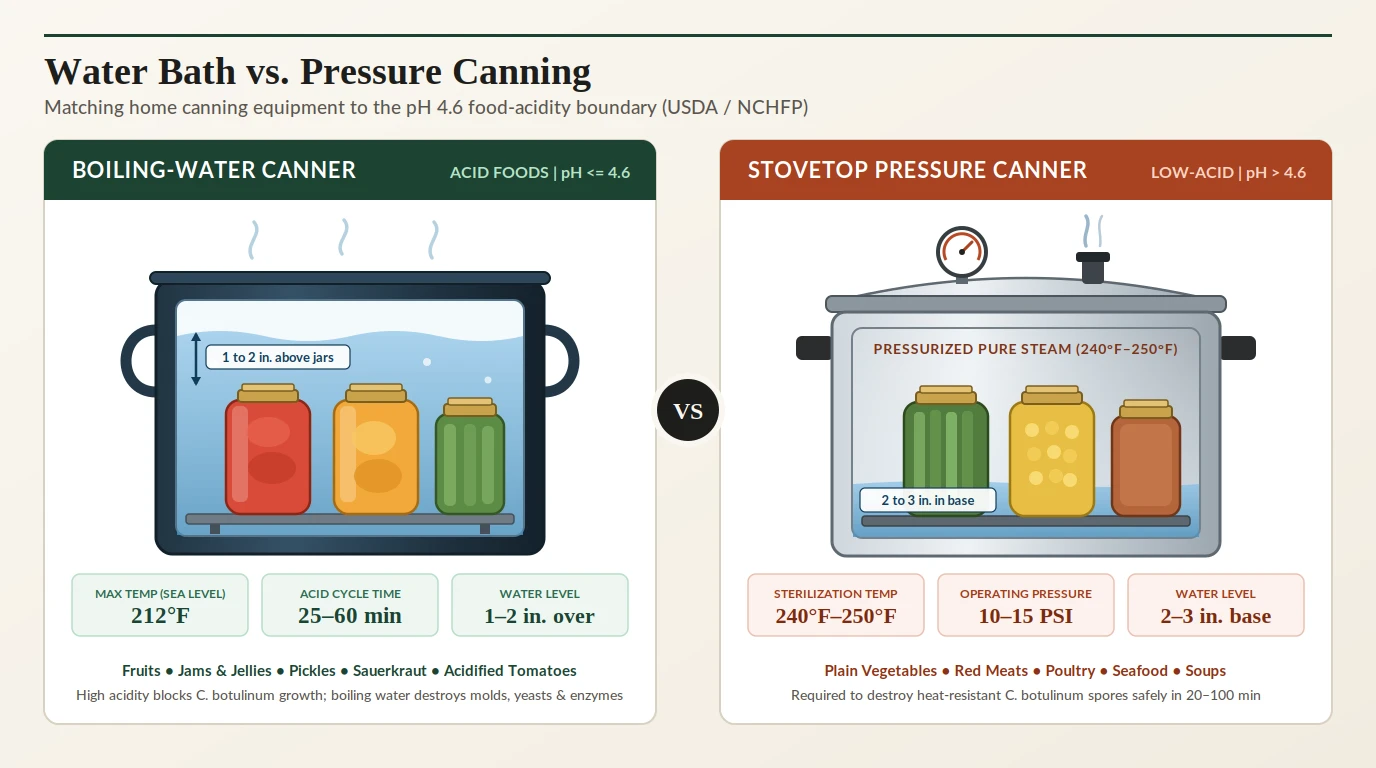
Use a water bath canner (212°F at sea level) for high-acid foods at pH 4.6 or lower—fruits, jams, pickles, and acidified tomatoes. Use a stovetop pressure canner (240°F to 250°F at 10 to 15 PSI) for all low-acid foods above pH 4.6—plain vegetables, meats, poultry, and seafood—to destroy botulism spores.
Home canning turns perishable produce and cooked foods into shelf-stable pantry goods only when heat processing matches the food’s acidity. Choosing the wrong vessel is not a texture trade-off; processing low-acid food in boiling water leaves heat-resistant spores alive inside a sealed, low-oxygen jar. For storage temperature and pantry rotation after jars seal, pair these rules with our food storage hub and pantry organization guide.
When Do You Use Water Bath Canning Versus Pressure Canning?
Food acidity at the pH 4.6 threshold determines the method: naturally acid or properly acidified foods at pH 4.6 or lower belong in a boiling-water canner, while every low-acid food above pH 4.6 must be processed in a stovetop pressure canner to eliminate Clostridium botulinum risks.
According to National Center for Home Food Preservation guidance on safe canned foods, Clostridium botulinum spores can germinate into vegetative cells and produce deadly botulism toxin within 3 to 4 days inside a moist, low-acid food held between 40°F and 120°F with less than 2 percent oxygen. Acid foods contain enough acidity to block spore growth or destroy bacteria rapidly in boiling water, requiring 5 to 85 minutes of boiling-water processing. Low-acid foods cannot rely on acidity; destroying botulism spores in boiling water would require 7 to 11 hours, whereas sterilizing at 240°F to 250°F in a pressure canner operated at 10 to 15 PSI takes 20 to 100 minutes depending on the food, pack style, and jar size.
Scroll horizontally to see all columns.
| Feature | Boiling-Water Canner | Stovetop Pressure Canner | Atmospheric Steam Canner |
|---|---|---|---|
| Food Acidity Scope | Acid foods (pH 4.6 or lower) | Low-acid foods (pH above 4.6); optional for acid foods | Acid foods only (pH 4.6 or lower); never low-acid |
| Processing Temperature (Sea Level) | 212°F in briskly boiling water | 240°F to 250°F (240°F at 10.5 PSI in air-free pure steam) | 212°F in vented pure steam |
| Operating Pressure | Atmospheric (unpressurized) | 10 to 15 PSI (do not exceed 15 PSI on new canners) | Atmospheric (unpressurized) |
| Water Depth in Canner | 1 to 2 inches above jar tops (at least 2 inches if over 30 minutes) | 2 to 3 inches deep in base with jars inside (more for long processes) | Base filled per manufacturer; cannot open to add water |
| Typical Jar Capacity | Most hold 7 quart jars or 8 to 9 pints | Standard 7 quarts or 8 to 9 pints; small 4 quarts; large up to 18 pints in two layers | Dome-style batch of high-acid jars |
| Processing Time Range | 5 to 85 minutes active boil (25 to 60 minutes total for most acid foods) | 20 to 100 minutes at pressure (55 to 100 minutes total for acid loads) | 45 minutes or less total, including altitude adjustments |
Which Vegetables Require Pressure Canning vs Water Bath Canning?
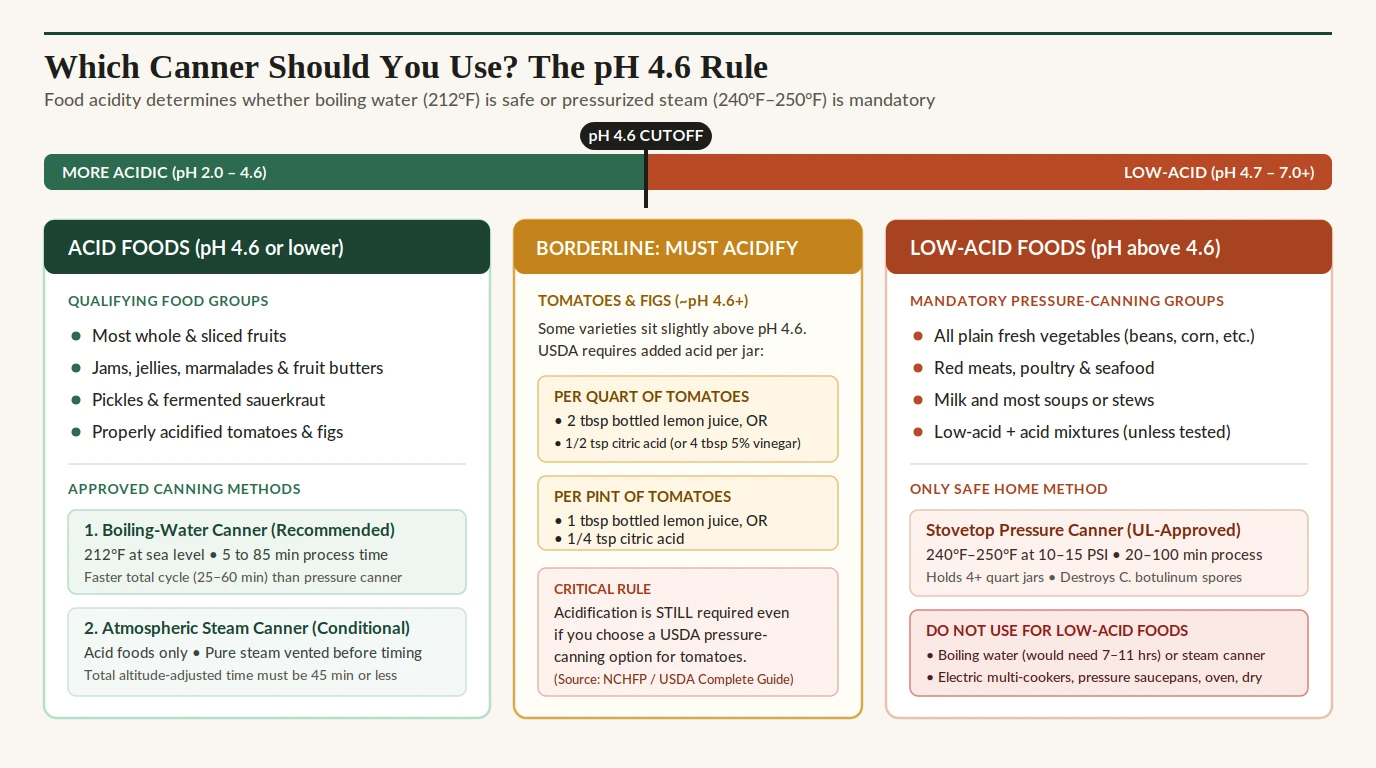
All plain fresh vegetables—including beans, corn, carrots, potatoes, and greens—have pH values above 4.6 and require a stovetop pressure canner. Vegetables may be water-bath canned only when pickled or fermented into acid foods (pH 4.6 or lower) such as pickles and sauerkraut, or when borderline tomatoes are properly acidified.
Plain Fresh Vegetables and Low-Acid Mixtures
Under USDA and NCHFP definitions, low-acid foods with pH values higher than 4.6 encompass red meats, seafood, poultry, milk, and all fresh vegetables except most tomatoes. Most mixtures of low-acid and acid ingredients—such as soups, stews, or vegetable-heavy sauces—also finish above pH 4.6 unless a research-tested recipe supplies enough lemon juice, citric acid, or vinegar to lower the equilibrium pH to 4.6 or below. Pickled vegetables and fermented sauerkraut cross into the acid category only because added acid or fermentation brings them to pH 4.6 or lower.
Acidifying Borderline Tomatoes and Figs
Although tomatoes are commonly grouped with acid foods, some varieties—and figs—have pH values slightly above 4.6. Per NCHFP tomato canning guidelines, to ensure safe acidity in whole, crushed, or juiced tomatoes, add 2 tablespoons of bottled lemon juice or 1/2 teaspoon of citric acid per quart (1 tablespoon of bottled lemon juice or 1/4 teaspoon of citric acid per pint), or 4 tablespoons of 5 percent acidity vinegar per quart.
Even when a USDA tomato recipe lists both boiling-water and pressure-canning options, every preparation step—including acidification—remains mandatory under the pressure option because those pressure schedules were not calculated for unacidified tomatoes. If you prefer to preserve cooked tomato sauce without adding acid or running a canner, follow our how to freeze tomato sauce guide instead.
Scroll horizontally to see all columns.
| Food Category | Acidity Class (pH) | Approved Canning Method | Required Preparation or Safety Rule |
|---|---|---|---|
| Most fruits, jams, jellies, marmalades, fruit butters | Acid (pH 4.6 or lower) | Boiling-water canner (or atmospheric steam canner if 45 minutes or less) | Follow research-based boiling-water schedule adjusted for elevation |
| Pickles and sauerkraut | Acid (pH 4.6 or lower) | Boiling-water canner (or atmospheric steam canner if 45 minutes or less) | Rely on tested vinegar or fermentation ratios to stay at pH 4.6 or lower |
| Tomatoes and figs | Borderline (some slightly above pH 4.6) | Boiling-water canner (or USDA pressure option for tomatoes) | Acidify tomatoes with 2 tbsp bottled lemon juice or 1/2 tsp citric acid per quart (1 tbsp or 1/4 tsp per pint), or 4 tbsp 5 percent vinegar per quart—required even when pressure canning |
| All plain fresh vegetables | Low-acid (pH above 4.6) | Stovetop pressure canner only | Process at 240°F to 250°F (10 to 15 PSI); never water-bath or dry-can without covering liquid |
| Red meats, poultry, seafood, milk | Low-acid (pH above 4.6) | Stovetop pressure canner only | Sterilize at 240°F to 250°F (10 to 15 PSI) for 20 to 100 minutes per USDA schedule |
| Low-acid and acid mixtures | Most are low-acid (pH above 4.6) | Stovetop pressure canner unless tested as acid | Must be pressure canned unless a tested recipe adds sufficient lemon juice, citric acid, or vinegar |
Can You Pressure Can High-Acid Foods?
Yes, pressure canners may also be used to process acid foods when a USDA pressure option exists, but NCHFP recommended canner guidance recommends boiling-water canners because they finish faster—taking 25 to 60 minutes total for most acid foods instead of 55 to 100 minutes in a pressure canner.
The speed gap comes from the extra venting, pressurization, and depressurization stages required by a sealed kettle. Processing a load of acid food in a pressure canner takes 55 to 100 minutes total: roughly 12 to 15 minutes of heating before venting, 10 minutes of continuous steam venting, 5 minutes to pressurize, 8 to 10 minutes of processing time for the acid food, and 20 to 60 minutes to cool before jars can be removed. By contrast, a loaded boiling-water canner heats for about 20 to 30 minutes before boiling and completes most acid foods in 25 to 60 minutes total.
What Water Level and Operating Steps Apply to Water Bath vs Pressure Canning?
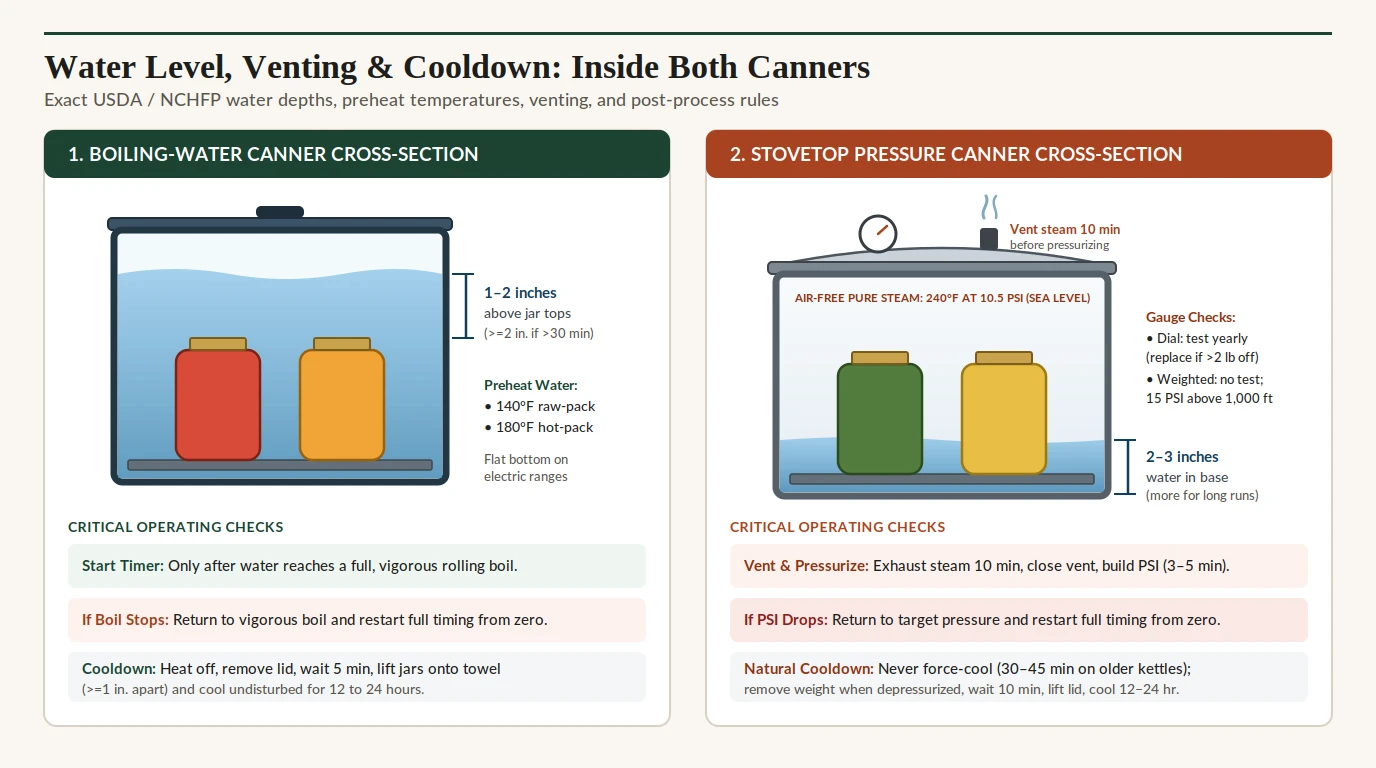
Boiling-water canning submerges jars completely under at least 1 inch of briskly boiling water—or at least 2 inches for process times over 30 minutes—whereas pressure canning uses only 2 to 3 inches of water in the kettle base to generate pressurized pure steam around the jars.
Water Bath Canning Water Level and Boiling Rules
Boiling-water canners are built from aluminum or porcelain-covered steel with removable perforated racks and fitted lids. On an electric range, use a flat-bottom canner no more than 4 inches wider in diameter than the heating element so heat distributes evenly; gas burners accept flat or ridged bottoms.
Fill the pot about halfway with clean water—adjusted so filled jars sit 1 to 2 inches below the surface—and preheat water to 140°F for raw-packed foods or 180°F for hot-packed foods. Keep at least 1 inch of water over jar tops during the boil, and at least 2 inches for process times over 30 minutes. If the water stops boiling at any point, bring it back to a vigorous boil and restart the full timing from the beginning. Once the timer ends, turn off the heat, remove the lid, wait 5 minutes before lifting jars out, space jars at least 1 inch apart on a towel, and let them cool undisturbed for 12 to 24 hours.
Pressure Canner Water Depth, Venting, and Cooldown Rules
Use only a pressure canner carrying Underwriter’s Laboratory (UL) approval. Standard models hold 7 quart jars or 8 to 9 pints, small pressure canners hold 4 quart jars, and some large models hold 18 pint jars in two layers (7 quart jars).
Place the rack and hot water (140°F for raw-packed foods or 180°F for hot-packed foods) about 2 inches deep into the kettle, then adjust so water sits 2 to 3 inches deep (or as the USDA recipe specifies) once filled jars are loaded; longer processes require more water. Because pressure itself does not kill microorganisms—high temperature in air-free pure steam does, reaching 240°F at 10.5 pounds gauge pressure at sea level—trapped air lowers the internal temperature at 5, 10, or 15 PSI and causes under-processing. Every pressure canner must therefore exhaust a steady flow of steam through the open vent port for 10 minutes before placing the weight or closing the petcock; pressurization then takes 3 to 5 minutes.
If pressure falls below the target at any point during timing, bring the canner back to pressure and restart the full original processing time from zero. When timing finishes, turn off heat and let the kettle depressurize naturally—never force-cool with cold water or open the vent early, which risks under-processing, liquid loss, seal failures, or warped lids. Heavy-walled older kettles without dial gauges require about 30 minutes to depressurize for pints and 45 minutes for quarts. After full depressurization, remove the weight or open the petcock, wait 10 minutes before lifting the lid away from your face, and cool jars undisturbed for 12 to 24 hours. Store properly sealed jars below 95°F, ideally between 50°F and 70°F for best quality.
Dial-Gauge Testing and High-Altitude Adjustments
Because water boils at lower temperatures as elevation climbs, NCHFP boiling-point elevation tables and USDA guidelines require altitude adjustments starting at 1,000 feet or more—longer boiling times for water-bath canning and higher gauge pressure for pressure canning.
Scroll horizontally to see all columns.
| Elevation Above Sea Level (feet) | Water Boiling Point (°F) | Adjustment Principle |
|---|---|---|
| 0 (Sea Level) | 212°F | Baseline USDA sea-level time and pressure (240°F at 10.5 PSI in pressure canner) |
| 2,000 | 208°F | Increase water-bath process time or pressure-canner PSI (adjustments begin at 1,000 feet) |
| 4,000 | 204°F | Higher water-bath time; USDA stovetop low-acid canning requires 13 to 15 PSI above 3,000 feet |
| 6,000 | 201°F | Follow elevation-specific USDA schedule; do not exceed 15 PSI on new pressure canners |
| 8,000 | 197°F | Follow elevation-specific USDA schedule for reduced atmospheric boiling point |
| 10,000 | 194°F | Follow elevation-specific USDA schedule for reduced atmospheric boiling point |
Dial-gauge and weighted-gauge pressure canners handle calibration and altitude differently:
- Dial-gauge pressure canners: Have dial gauges tested for accuracy before use every year (available at many county Cooperative Extension offices). You can adjust processing pressure if a gauge reads up to 2 pounds high or low, and you must replace any gauge that differs by more than 2 pounds.
- Weighted-gauge pressure canners: Weighted gauges control pressure accurately without annual testing, but they cannot step in 1-pound increments for elevation; above 1,000 feet, they must be operated at 10 PSI instead of 5 PSI, or 15 PSI instead of 10 PSI. New pressure canners should not be operated above 15 PSI.
Can You Use a Regular Pressure Cooker or Electric Multi-Cooker for Canning?
No—neither small stovetop pressure saucepans nor electric programmable pressure cookers (EPPCs) are approved for low-acid pressure canning. NCHFP states that pressure saucepans with smaller volume capacities are not recommended for canning, and Utah State University Extension testing concluded that EPPCs of any brand should not be used for low-acid canning.
In Utah State University Extension’s high-altitude EPPC study, researchers tested three electric pressure cooker brands with raw green beans, cooked chicken strips, and cooked pinto beans at 2,900 feet, 4,500 feet, and 7,100 feet against the commercial botulism-cook benchmark of 250°F for 2.5 minutes inside the jar. Food was frequently under-processed across all three altitudes and showed run-to-run inconsistency even with the same food, appliance, and elevation.
Three mechanical differences explain why regular electric cookers fail pressure-canning standards:
- Lower working pressure: USDA stovetop low-acid canning guidelines require 13 to 15 PSI above 3,000 feet, whereas electric programmable cookers ramp to a maximum pressure and then back down to a lower working pressure.
- No 10-minute air-venting step: Most electric multi-cookers lack a continuous 10-minute steam vent to purge pockets of cold air before pressurizing, creating uneven jar temperatures.
- Truncated cooldown: In USDA stovetop pressure-canning schedules, most thermal destruction of botulism spores occurs during the long natural cooldown cycle, which electric cookers calling for quick release cut short.
Utah State University Extension notes one narrow high-acid exception: an EPPC may be used for small-batch water-bath canning of high-acid foods (below pH 4.6) only if jars sit on a rack submerged under at least 1 to 2 inches of water at a full rolling boil for the altitude-adjusted USDA time with the pressure lid left unlocked. EPPCs have not been studied as atmospheric steam canners. Under NCHFP’s list of unrecommended equipment and methods, open-kettle canning, conventional ovens, microwave ovens, dishwashers, canning powders, and dry canning vegetables without their researched covering liquid are also unsafe and not recommended.
Are Atmospheric Steam Canners Approved by the USDA and NCHFP?
Yes, atmospheric steam canners are approved for naturally acid or properly acidified foods (pH 4.6 or below) using USDA and NCHFP boiling-water process times, provided strict operational controls are met. Because they are non-pressurized vessels, atmospheric steam canners can never be used for low-acid foods.
Following collaborative peer-reviewed research by the University of Wisconsin (led by Dr. Barbara Ingham) and the National Center for Home Food Preservation, safe atmospheric steam canning requires five non-negotiable controls:
- Acidity at pH 4.6 or below: Process only naturally acid or properly acidified recipes with research-based boiling-water times.
- Full air venting before timing: Vent air out so pure steam around the jars reaches boiling-water temperature at the start and throughout processing.
- Preheated jars: Preheat jars before filling and minimize cooling between filling and processing.
- 45-minute total processing cap: Total processing time—including any altitude increase—must be 45 minutes or less, and you cannot open the canner to add water or for any other reason during the cycle.
- Still ambient-air cooling: Let jars cool naturally in still room air with no forced cooling, because slow post-process cooling contributes to total lethality.
If a home recipe exceeds 45 minutes, lacks a tested canning schedule, or uses low-acid ingredients without a stovetop pressure canner on hand, freeze the batch instead using our freezing food in Mason jars guide, or compare cold-storage container seals in airtight vs vacuum-sealed storage.
Frequently Asked Questions
What happens if you water bath can low-acid vegetables or meat?
Water-bath canning reaches only 212°F at sea level, which does not destroy heat-resistant Clostridium botulinum spores in a practical time frame (low-acid foods would need 7 to 11 hours in boiling water). Inside a sealed, moist, low-acid jar with less than 2 percent oxygen stored between 40°F and 120°F, surviving spores can grow and produce deadly botulism toxin within 3 to 4 days.
How much water goes into a water bath canner vs a pressure canner?
A boiling-water canner requires enough water to cover jar tops by at least 1 inch—and at least 2 inches for process times over 30 minutes—preheated to 140°F for raw-packed food or 180°F for hot-packed food. A stovetop pressure canner uses only 2 to 3 inches of hot water in the base with jars inside (starting around 2 inches, or more when a USDA recipe for a longer process directs).
Do you still need to add lemon juice or citric acid if you pressure can tomatoes?
Yes. USDA tomato canning procedures that offer a pressure-canning option still require full acidification (2 tablespoons of bottled lemon juice or 1/2 teaspoon of citric acid per quart, 1 tablespoon or 1/4 teaspoon per pint, or 4 tablespoons of 5 percent acidity vinegar per quart) because those pressure schedules were not developed for unacidified tomatoes.
Can I use an electric pressure cooker for canning?
Do not use electric programmable pressure cookers of any brand for low-acid pressure canning; Utah State University Extension testing at 2,900, 4,500, and 7,100 feet found frequent under-processing and inconsistent temperatures. They may be used only for small-batch boiling-water canning of high-acid foods (below pH 4.6) with 1 to 2 inches of water above jar tops at a full rolling boil and the pressure lid unlocked.
When is an atmospheric steam canner safe to use?
An atmospheric steam canner is safe only for acid or properly acidified foods at pH 4.6 or below following USDA or NCHFP boiling-water recipes when air is vented to pure boiling-temperature steam, jars are preheated, total altitude-adjusted processing time is 45 minutes or less without opening the lid, and jars cool in still ambient air. Never use one for low-acid foods.
Explore more in Food Storage & Freezer Guides.
Official guidance and sources
Sources last checked November 22, 2026.
- How to Use Boiling Water and Pressure Canners , National Center for Home Food Preservation, University of Georgia (accessed November 22, 2026)
- Ensuring Safe Canned Foods , National Center for Home Food Preservation, University of Georgia (accessed November 22, 2026)
- Canning Tomatoes, Introduction , National Center for Home Food Preservation, University of Georgia (accessed November 22, 2026)
- Equipment and Methods Not Recommended , National Center for Home Food Preservation, University of Georgia (accessed November 22, 2026)
- National Center Burning Issue: Using Atmospheric Steam Canners , National Center for Home Food Preservation, University of Georgia (accessed November 22, 2026)
- Why Electric Pressure Cookers Are Not Pressure Canners , Utah State University Extension (accessed November 22, 2026)
- Temperatures at which Water Boils at Different Elevations , National Center for Home Food Preservation, University of Georgia (accessed November 22, 2026)