
How to Freeze Soup in Useful Portions
Cool the soup, divide it into single-meal portions, leave room to expand, label the date and thaw it safely. A practical guide to freezing homemade soup.
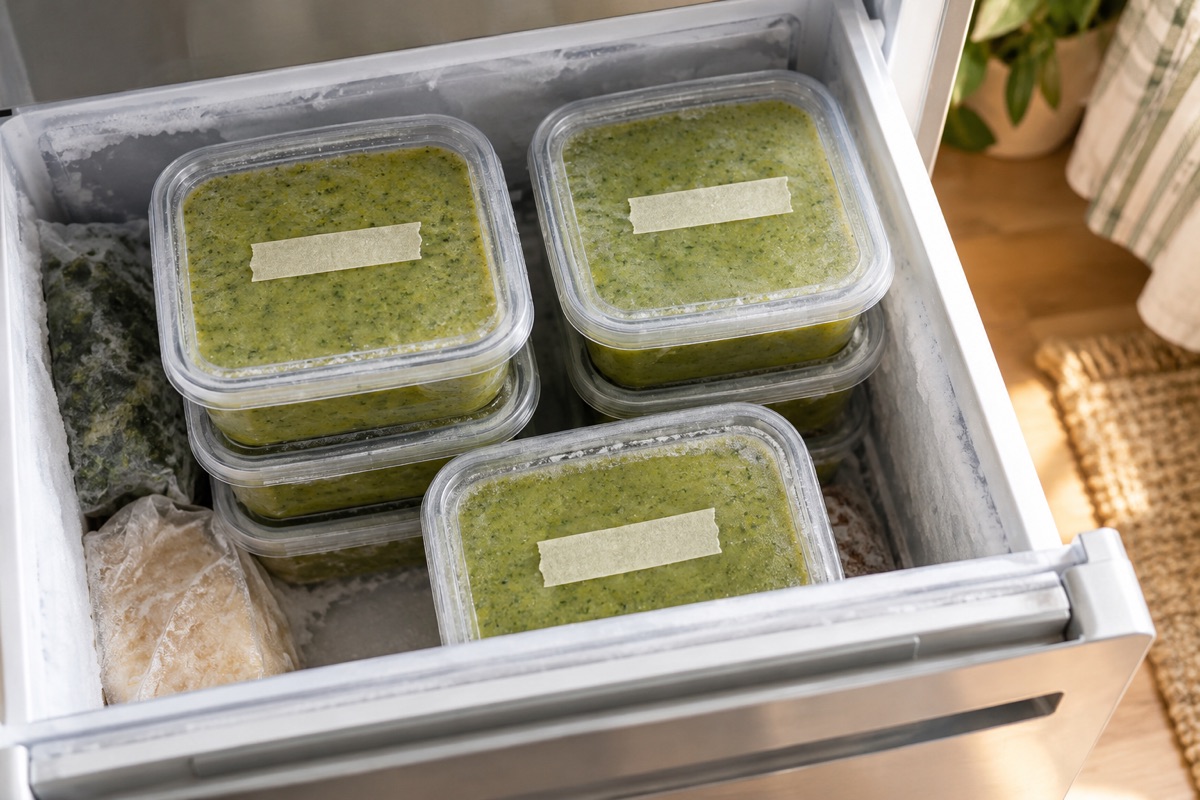
To freeze soup well, cool it quickly, divide it into the amounts you will actually eat, leave empty space at the top for expansion, label the container with the date and freeze it promptly. Single-meal portions in shallow or flat containers cool, freeze and thaw faster and save you from thawing more than you need.
This guide applies to readers in the United States and was last reviewed on October 4, 2026. Time and temperature figures come from USDA FSIS and FoodSafety.gov. Packaging and headspace points come from university extension material.
Which soups freeze well
Most brothy and puréed soups freeze acceptably, but some ingredients change. The National Center for Home Food Preservation lists several foods that do not freeze well, and four matter for soup.
Boiled or baked potatoes can turn soft, crumbly, water-logged and mealy after thawing. Puréed potato may be less noticeable than chunks, but plan on a texture change. Cooked pasta, macaroni and rice can turn mushy when frozen alone, so a common workaround is to freeze the soup base and add freshly cooked pasta or rice when you reheat.
Milk sauces may curdle or separate. A cream-based soup such as cream of spinach soup may look grainy after thawing, so some cooks freeze the base and stir in cream when reheating. That is a general approach, not a tested result. Cream or custard fillings and sour cream can also separate and turn watery or lumpy.
Bread-thickened soups such as tomato bread soup are mostly a texture question. Bread softens further in liquid, so freezing the soup base and adding bread when you reheat gives you more control. Again, that is a practical suggestion and not a result.
Steps
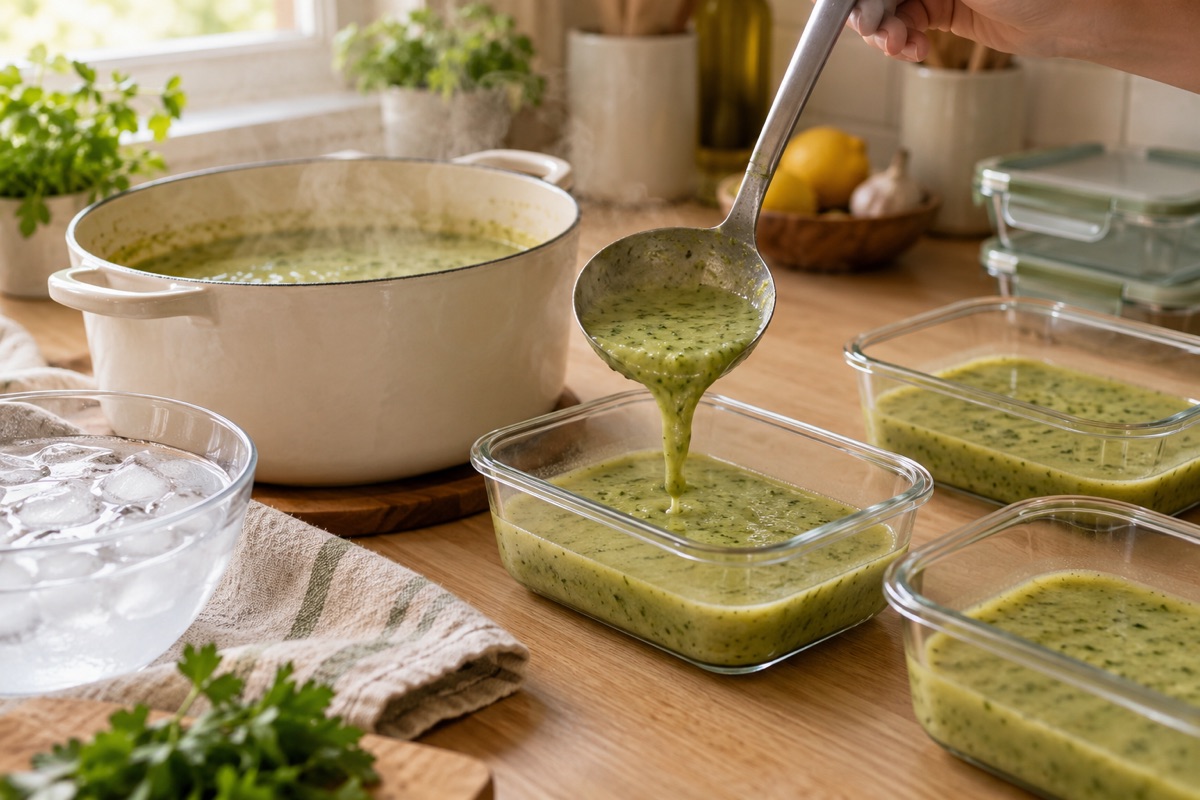
- Cool the soup rapidly. USDA FSIS says to cool food so it reaches 40°F or below as fast as possible. A big pot of soup takes a long time to cool, which gives bacteria time to multiply, so divide it into smaller, shallow containers. Hot food can go directly into the refrigerator or be chilled first in an ice or cold water bath.
- Watch the 2-hour limit. FSIS says leftovers must be refrigerated within 2 hours of cooking, or within 1 hour if the temperature is above 90°F, and that perishable food left out longer should be thrown away.
- Portion it by who eats it: one lunch bowl, dinner for two or a family pot. Smaller portions also cool and freeze faster.
- Fill the container, leaving headspace. Liquid expands as it freezes.
- Wipe the rim so the lid seals, and label before freezing.
- Freeze promptly, with a little space between new packages so cold air can circulate. Once frozen, you can pack them closer.
Portions and headspace
Large containers freeze slowly. The National Center for Home Food Preservation says foods in larger containers freeze too slowly to give a satisfactory product, and for fruits and vegetables it advises against containers over one-half gallon. That limit is written for produce, not soup, but the idea carries over: smaller portions freeze faster and more evenly.
Headspace is the empty room between the food and the lid. The extension chart for liquid packs of fruit and vegetables gives these allowances:
| Container opening | Pint | Quart |
|---|---|---|
| Wide top opening | 1/2 inch | 1 inch |
| Narrow top opening | 3/4 inch | 1 1/2 inches |
This chart covers fruit and vegetable liquid packs, not soup specifically, so use it as a reference point and leave a bit more room if the container is narrow at the top. Check any instructions that come with your containers.
Containers: rigid, bags and jars
The National Center for Home Food Preservation says rigid plastic or glass containers are suitable for all packs and especially good for liquids. Straight sides make frozen blocks easier to remove, and rigid containers stack well. Flexible freezer bags also work for liquid packs, and the source says to press out as much air as possible before sealing.
- Rigid plastic containers are reusable and stackable. The source says covers should fit tightly, and that freezer tape can reinforce a loose lid.
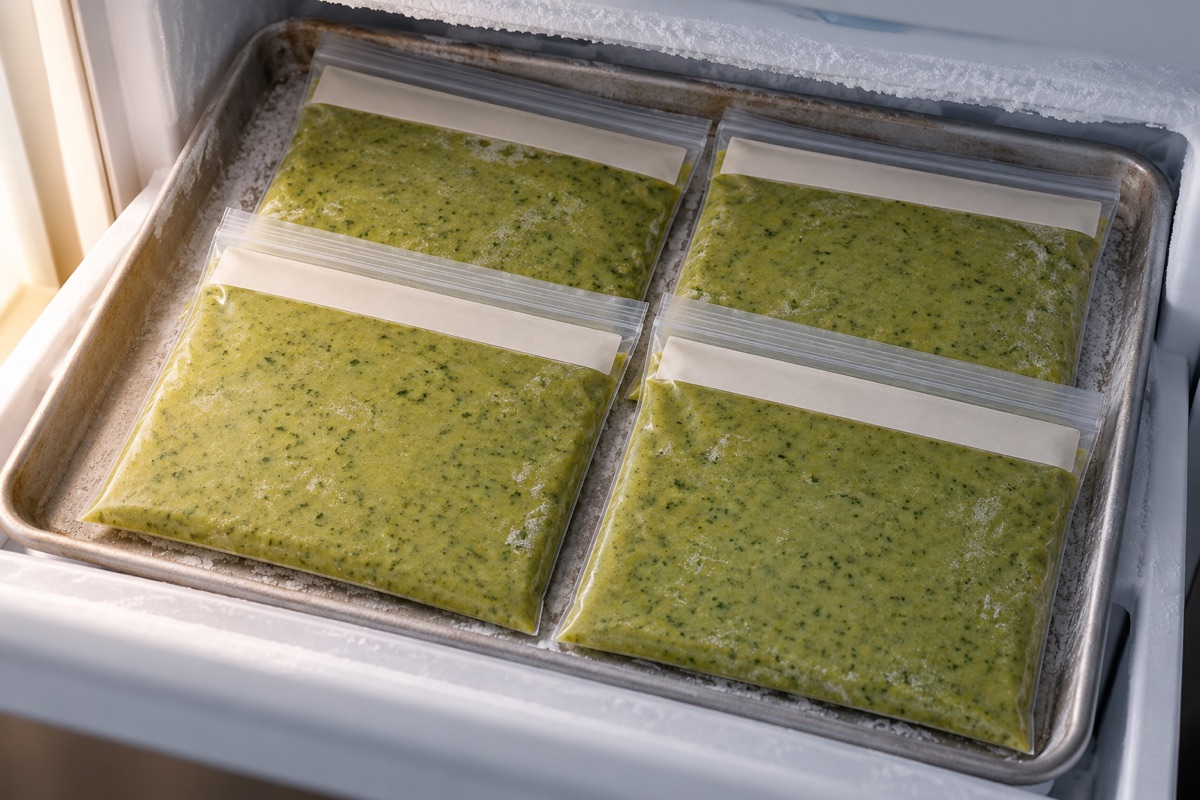
- Flat freezer bags laid flat on a tray freeze into thin slabs that take less room. Support the bag in a container or on a sheet while it fills so it does not leak.
- Glass jars break easily at freezer temperatures if they are regular jars, according to the same source. If you use glass, choose wide-mouth jars made for both freezing and canning, and leave extra headspace in narrow-mouth jars because expansion can break them at the neck.
- Cardboard cartons are not sufficiently moisture-vapor resistant for long-term freezer storage unless lined with a freezer bag or wrap.
Airtight containers and vacuum sealing work differently, and vacuum sealing is not suited to liquid soup unless it is frozen solid first.
Labels
Label each package with the product name, the date, the number of servings and any notes, such as “base only, add cream” so you know what to do later. Use freezer tape, markers or labels made for freezer use. Keep the oldest packages at the front and use them first.
Refrigerator, freezer and reheating
FoodSafety.gov lists soups and stews with vegetables or meat added at 3 to 4 days in a refrigerator at 40°F or below. FSIS gives the same 3 to 4 days for leftovers in general.
In the freezer, FoodSafety.gov lists 2 to 3 months for soups and stews at 0°F or below. It states that freezer guidelines are for quality only, and that food kept continuously at 0°F or below can be kept indefinitely. FSIS’s leftovers page adds that frozen leftovers are safe indefinitely but can lose moisture and flavor when stored longer. So treat 2 to 3 months as a quality target, and use the date on the label to plan.
FSIS lists three safe ways to thaw leftovers: in the refrigerator, in cold water and in the microwave. Refrigerator thawing is slowest but keeps food safe the whole time, and thawed leftovers should be used within 3 to 4 days or can be refrozen. Cold water thawing needs a leak-proof bag, and food thawed that way should be cooked before refreezing. Microwave thawing is the fastest; heat the food until it reaches 165°F as measured with a food thermometer. FSIS also says it is safe to reheat frozen soup or stew without thawing, in a saucepan or microwave, though it takes longer.
For reheating, FSIS says leftovers should reach 165°F as measured with a food thermometer, and that sauces, soups and gravies should be brought to a rolling boil. Cover leftovers when you reheat so moisture stays in and the food heats through. In a microwave, cover and rotate the food, and check the temperature in several places because of cold spots.
If you thawed soup in the refrigerator, FSIS says it can be refrozen; soup thawed in cold water or the microwave should be cooked first. Quality may drop with each round, so freezing in small portions avoids the question.
Common questions
Can I freeze soup in glass jars? Only jars made for freezing, with extra headspace, and never filled to the brim. The extension source warns that ordinary jars break easily.
Why does my thawed soup look separated? Dairy, cream and starch thickeners can separate on thawing. Stirring over gentle heat may smooth it, but results vary by recipe.
How do I know if frozen soup is still good? Texture and flavor are quality cues, not safety tests. Use the date on the label and the time guidelines above.
What if my container or appliance manual says something different? Follow the manufacturer’s instructions for containers, jars and freezers.
Official guidance and review date
Reviewed October 4, 2026 for the United States. Time and temperature figures come from FoodSafety.gov’s cold food storage chart and USDA FSIS. Packaging, headspace and foods-that-freeze-poorly guidance comes from the National Center for Home Food Preservation at the University of Georgia. Product labels and manufacturer instructions take priority.
Official guidance and sources
Sources last checked October 4, 2026.
- Cold Food Storage Chart , FoodSafety.gov (accessed October 4, 2026) Refrigerator and freezer guidelines for soups and stews; freezer guidelines are for quality only.
- Leftovers and Food Safety , USDA Food Safety and Inspection Service (accessed October 4, 2026) Rapid cooling in shallow containers, the 2-hour rule, thawing, reheating and refreezing.
- Containers for Freezing , National Center for Home Food Preservation, University of Georgia (accessed October 4, 2026) Rigid containers, freezer bags and glass jar cautions.
- Headspace to Allow , National Center for Home Food Preservation, University of Georgia (accessed October 4, 2026) Chart written for liquid packs of fruits and vegetables; used as a reference point for liquid foods.
- Foods That Do Not Freeze Well , National Center for Home Food Preservation, University of Georgia (accessed October 4, 2026)